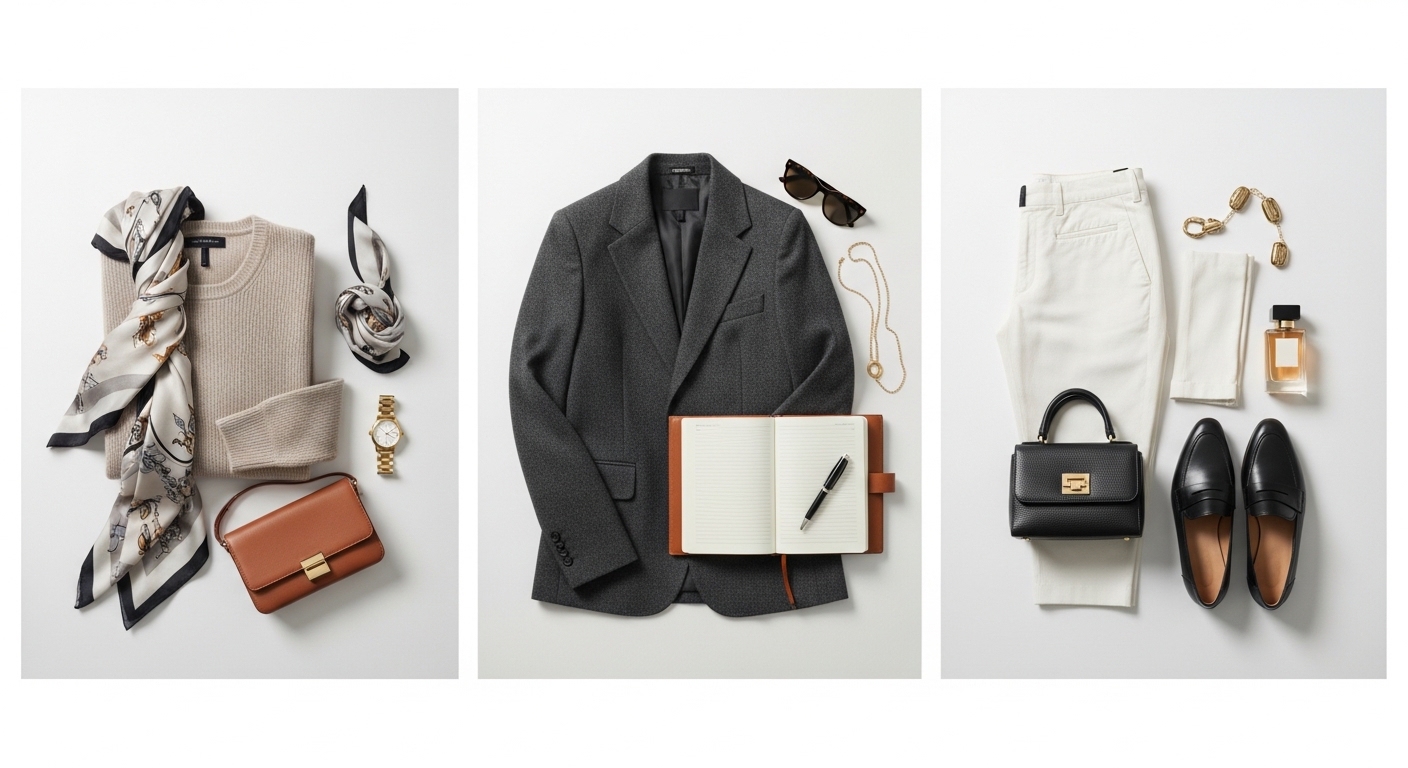
What a lookbook is, and why hybrid production
A lookbook is a series that arranges a collection's pieces into a visual narrative. What sets it apart from single product shots is the focus: how a garment is worn, what silhouette it holds, the atmosphere of the season. A buyer picks items from a catalog; from a lookbook they read the world of the collection. So consistency and tone matter more here than the sharpness of any single frame.
Hybrid production means using AI and traditional studio capture on the same project. A fully AI-built lookbook usually gets the real texture of a garment wrong, along with stitch detail and how fabric behaves under light. A fully traditional production demands a separate shoot for every background, location and variation. The hybrid flow sits between the two: it captures the garment's reality in the studio and extends the scene and variations with AI. The result is a wider visual set across fewer shoot days.
Step 1 — concept and AI moodboard
The work starts by reducing what the collection says to a single sentence. A starting point like "urban, plain, an autumn in grey tones" aligns every decision that follows. Once that sentence is clear we move to the moodboard. AI adds speed here: with a few prompts we can put dozens of reference frames carrying the light tone, color palette and sense of place in front of us within minutes.
The moodboard's purpose is not yet to produce final imagery but to lock the direction. At this stage we talk with the client across three or four atmospheres. Decisions like "this light or harder shadows" and "studio floor or a city location" get made here. We don't move to any later step until the concept is approved, because a late change of direction is the most expensive mistake.
Step 2 — styling, casting, and real vs virtual model
Once the concept is set we move to styling: which piece pairs with which combination and which accessory. These choices set the rhythm of the lookbook. Then casting comes, and here we make the most important call in hybrid production: real model or virtual model.
We pick a real model when we want to show the garment's true texture and movement, when face consistency for the brand matters, and when the real drape behavior needs to lead. We consider a virtual model when the variation volume is high, when the same look has to appear on several colors or sizes, and when location access is difficult. On most projects we use both: hero frames are real capture, variations and alternative scenes are AI-based. The decision shifts with the brand's need; there is no fixed recipe.
Step 3 — studio capture and the garment's real texture
This step is the backbone of the hybrid flow. We shoot the garment for real in the studio because the fabric's texture, the stitching, and how light breaks across the cloth are things AI can't produce reliably. The pilling of a wool coat, the sheen of silk, the fade of denim — these are caught in real capture.
At this stage we keep the light controlled and neutral. The aim is a clean base frame that suits later AI scene extension. We record every angle of the garment, its critical details, and how it sits in motion, each separately. The cleaner these base frames are, the more natural the background and location work looks in the next step. Skipping the studio shoot and starting from AI strips the collection's real identity out of the image.
Step 4 — backgrounds, locations and variation with AI
With clean studio frames in hand, AI comes in. We can show the same look on a city street, in an architectural space, or against an abstract floor, and all from one shoot. When we feed the light tone we locked at the concept stage as a reference, the scenes stay consistent with each other.
Variation widens here. We can produce versions of one look in three locations, in the light of two different days, and across a few color palettes. That lets us draw different formats from the same shoot for the campaign's channels: web, social, print catalog. The point is not to break the garment's reality: AI changes the scene, it does not redraw the garment. Holding that line is the key to keeping the lookbook trustworthy.
Step 5 — post-production and format delivery
In the last step we bring every frame into one visual language. Color match, contrast and tone have to be the same across the whole series, because an eye reading the lookbook as a single flow notices even the smallest inconsistency between frames. Here we make the transition between studio frames and AI-extended scenes invisible.
Delivery formats split by where they are used. Web-optimized images that load fast; vertical and square crops for social; high-resolution versions for the print catalog. We deliver this format set, all drawn from the same lookbook, in one package, so the brand doesn't enter a separate production process for each channel.
Lookbook production with PAM Istanbul
A lookbook works when the viewer can't tell which frame is real capture and which is AI. As we set that line we put the brand's need first: without breaking the garment's reality, holding the season's atmosphere, and thinking about every channel. With a production discipline built across 40+ brands, we keep every step of the process transparent.
If you want to talk through turning your collection into a lookbook, let's start with a discovery call. We'll plan together which frames are real capture and which extend with AI.
Let's build this together.
Whether it's a single season or a year-long production partnership, we bring the same playbook that works for Cartier, Mercedes-Benz, Nike and Pierre Cardin. We mentor your team as we deliver — transparent process, documented AI decisions, no black boxes.
Email: [email protected]
Phone: +90 530 267 49 29
Studio: Yayıncılar Sok. 10/3, Seyrantepe · Istanbul