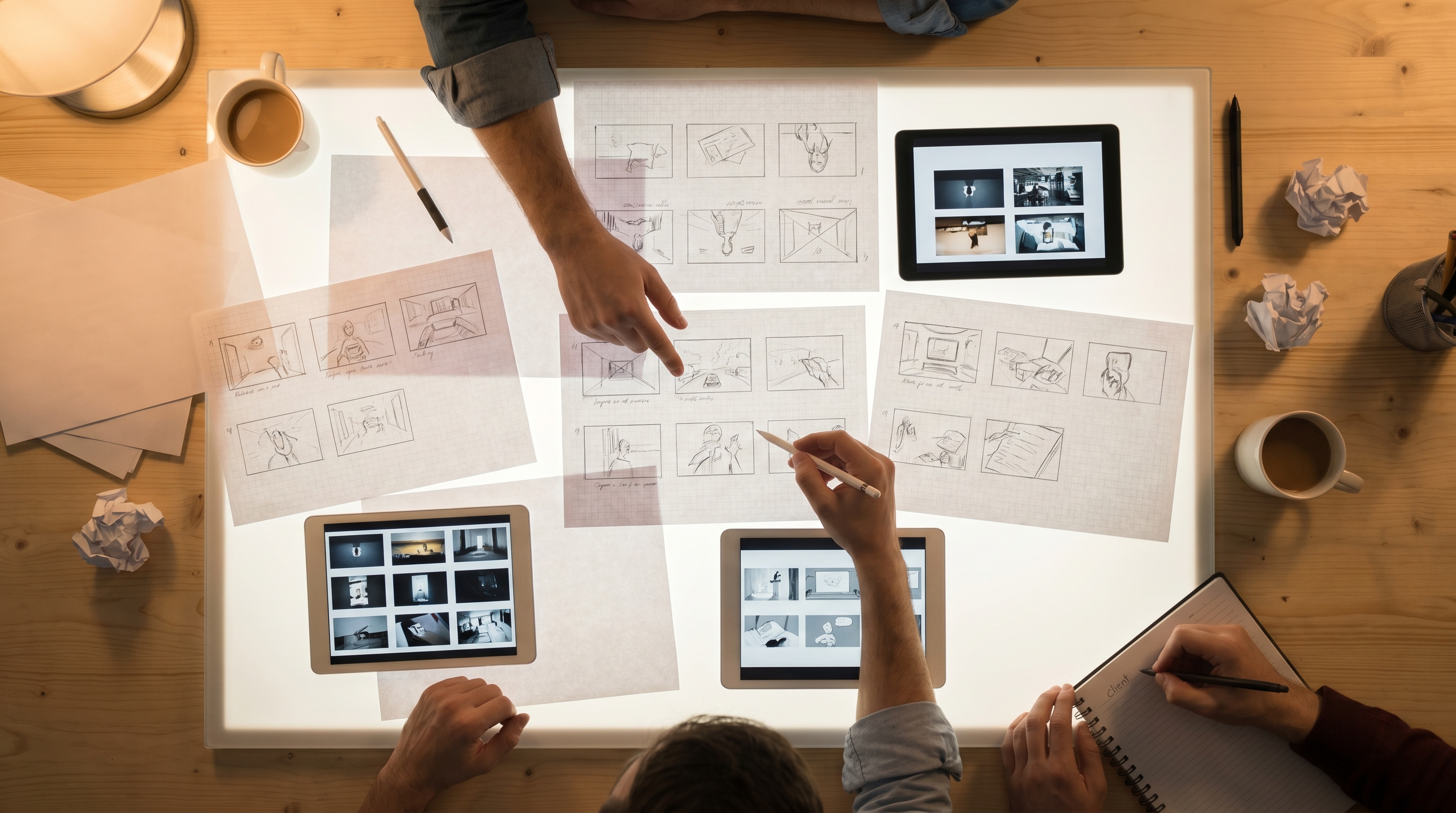
The shortest way to explain the difference between a storyboard and an animatic: a storyboard is a photo album, an animatic is a rough cut of the film. Both are pre-visualisation tools, but one cannot replace the other.
What is a storyboard?
A storyboard is a visual draft of the film drawn scene by scene. Each frame represents a shot: camera position, actor placement, composition. It's extremely useful for production planning — the director and DoP use it as a shared reference when going through the shotlist.
But when you show a storyboard to a client, here's what happens: the client looks at the drawings, says "OK," but can't actually picture the film in their head. There's no rhythm, no sound, no transitions. Static frames can't fully communicate a moving idea.
What is an animatic?
An animatic is the storyboard frames combined with rough animation or transitions, with voiceover and music added on top. It isn't the real film. But it's enough to give a feel for the film's rhythm, tempo and message.
A good animatic does this: the client watches and says "ah, so that's what will happen." With a bad storyboard presentation, the client says "looks great" right up to the shoot, then after the edit: "but that's not what I had in mind."
When is an animatic essential — and when can it be skipped?
An animatic is essential in these situations: when tempo and rhythm are central to the film (music spot, speed matters in a product demo), when there are multiple scene sequences, when VFX or post effects are heavy, or when the client has previously complained about "surprises after the shoot."
Cases where it can be skipped are more limited: a single-scene product film, when the client is familiar with the production process and agrees to proceed on storyboard approval alone. But these are exceptions, not the rule.
The risk of going to camera without animatic approval
It only takes one experience. The client approved the storyboard, the shoot happened. When the edit came in, the client said "the tempo is too fast, this isn't what I had in mind." Nearly the entire edit had to be revised. The post budget blew out. The animatic would have cost a few days of work; the revision cost weeks and significant money.
How much does a basic animatic cost, and how long does it take?
It depends on storyboard quality and animatic complexity. A basic animatic built from existing storyboard frames — with transitions, rough audio, temp music — can be completed in two to four business days. The cost is proportionally low. More sophisticated animatics (3D previs, AI-assisted visual generation) take longer and cost more, but on high-budget projects the investment pays off.
How to present it to the client
Sending an animatic by email with "here, take a look" is not the right approach. It should be presented in a meeting, with a proper sound system, in the presence of the director. When the director can say "in this scene we're pushing here because..." the client reads the film correctly. Watched alone over email, that context disappears — and the client, hearing low audio, seeing rough visuals, may conclude "I didn't really get it" and draw wrong conclusions.