Brief and strategy: asking the right questions
Every good film starts with a good brief. But a brief is usually incomplete, because the brand side describes what they feel rather than what they want. Our first job is to fill that gap. We don't move to a single frame until we're clear on who the film is speaking to, which channel it will run on, and what we expect the viewer to do after seeing it. A product launch, a brand story, a performance-driven sales film — each of these follows a separate production path.
The questions we ask the client at this stage are sometimes uncomfortable: "Would it matter if your competitor had made this film?", "In one sentence, what are you trying to say?". As the answers sharpen, so does the direction. Thinking about visuals before strategy is settled is the start of mistakes that can't be fixed later on set. We turn the brief into a document we've written together and get it approved; every decision after that rests on that document.
Concept and moodboard: fast visualisation with AI
Once strategy is approved, we make the idea visible. This stage used to mean collecting reference films, pulling images off the web, and building a moodboard by hand. Now AI speeds that part up noticeably. With Midjourney or similar tools we can put the right atmosphere, light tone, and colour palette in front of you within hours and draw out three or four distinct directions.
What matters here: the AI moodboard is not the film itself, it's the rehearsal of the idea. When a client says "yes" to a direction, all the work of carrying that direction onto a real set still sits with the team. The AI contribution is time: compressing a concept presentation from days to hours, getting on the same page with the client earlier, and avoiding effort spent on the wrong direction. Once the concept lands, the film's tone, rhythm, and visual language sit in one reference set.
Storyboard and pre-production
The approved concept becomes a storyboard. The storyboard is the frame-by-frame plan of the film; it lets you see the film on paper before the shoot. Which shot is wide and which is close, where a camera move starts and ends — all of that is decided here. A good storyboard removes guesswork on the shoot day.
Pre-production is the most intense but least visible part of the process. Casting happens, the actor or model is chosen. The location is found, permits are secured, the shoot schedule is built. The lighting plan, equipment list, and art department needs are settled one by one. A detail missed at this stage — a wrong location permit, a missing prop — costs hours lost on the shoot day. At PAM we run pre-production with the discipline of a checklist, because the most expensive thing on a set is waiting.
The shoot day: the value of a real set
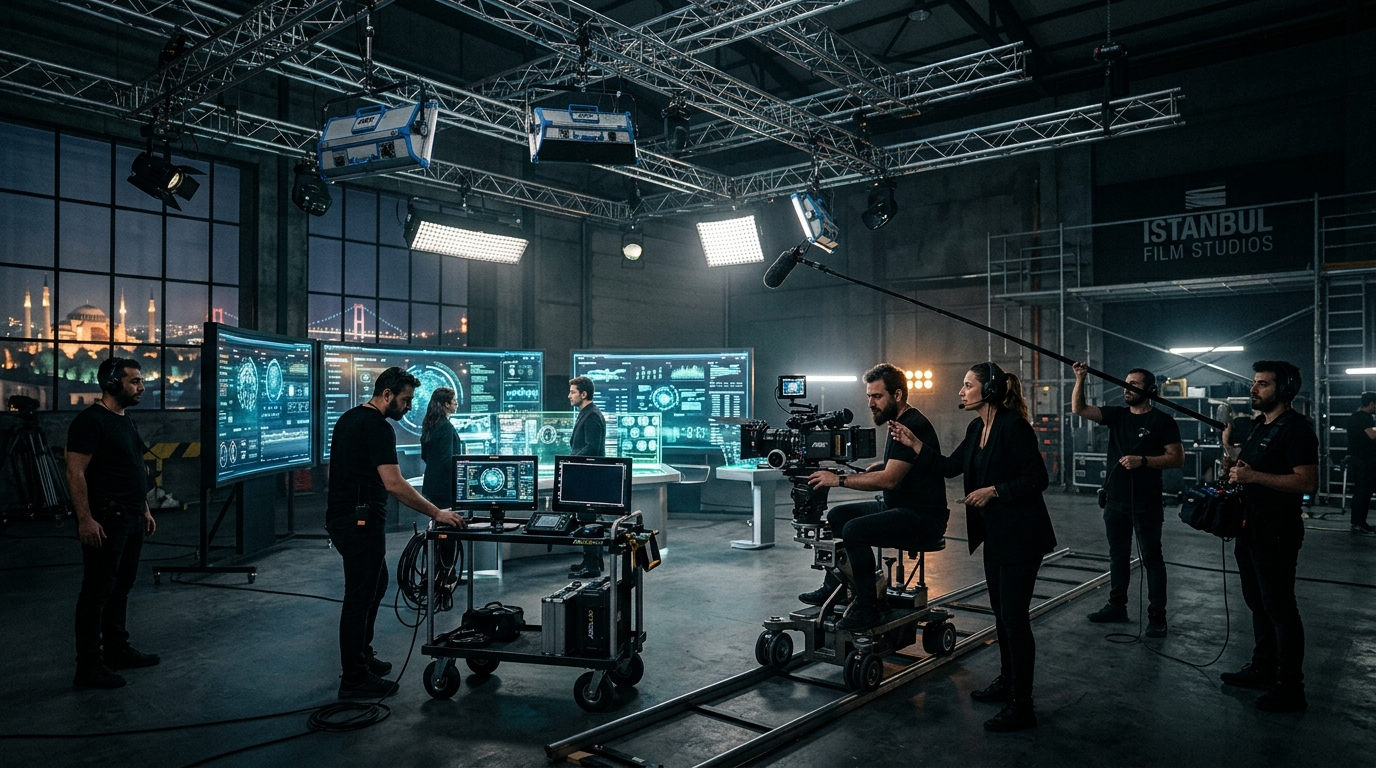
The shoot day is when all the preparation is tested. Camera, light, talent, art, and director work at the same time. There is a lot AI can't do at this stage: how real light breaks across a face, an actor's energy in the moment, the genuine texture of a location. These are the details that give a film its credibility, and the answer to why a set is still essential.
A well-run set stays faithful to the storyboard but also stays open to the opportunities the moment brings. Sometimes an unplanned frame turns out to be the strongest in the film. On the shoot day our job is to combine the confidence of preparation with instinct. When the client is on set, they can follow and approve every shot from the monitor, so nothing surprising is left for post.
Post-production: edit, colour, sound and AI acceleration
The shoot ends, and the real film takes shape in post-production. The edit sets the dozens of shots into a rhythm. Colour grading defines the film's emotion; the same footage feels completely different in a cool or a warm tone. Sound design and music are the layer the viewer is affected by without noticing.
AI speeds up many repetitive jobs at this stage. Shot selection for a rough cut, noise removal, automatic subtitles, reframing for different aspect ratios — these are now jobs that take minutes. Producing horizontal, vertical, and square versions of a commercial used to be a separate effort; today it's far faster. But the creative calls — which frame stays, what emotion the colour carries — are still human. AI compresses time; it doesn't replace craft.
Multi-format delivery and launch
A modern commercial is not a single file. The same campaign is delivered as a 30-second cut for television, a 15-second vertical for Instagram, a 6-second bumper for YouTube, and a long version for the web. Each channel has its own technical requirements: resolution, codec, audio standard, safe area. Setting the delivery plan at the start of the project prevents re-edits later.
At the launch stage our job doesn't end with handover. Where, how, and in what order the film runs directly shapes the campaign's impact. The brand's media plan and the creative content need to support each other. Alongside every format we deliver, we leave a short usage note, so the right version runs in the right place.
PAM Istanbul's hybrid approach
For us, AI is a layer that speeds production up, not one that changes it. We use AI in concept, variation, and repetitive post work; humans stay on strategy, set, and creative calls. This hybrid method gives the client two things: seeing the process earlier and reaching the same quality of result faster. Throughout the process we document every AI decision, no black box.
The discipline we learned working with brands like Cartier, Mercedes-Benz, Nike and Pierre Cardin is exactly this: move stage by stage, stay on the same page with the client at each stage, and leave no surprises. A commercial film, when set up right, runs on a plan rather than a guess.
Let's build this together.
Whether it's a single campaign or a year-long production partnership, we bring the same discipline. Let's write your film's brief together and set up the right process together. We mentor your team as we deliver — transparent process, documented AI decisions, no black boxes.
Email: [email protected]
Phone: +90 530 267 49 29
Studio: Yayıncılar Sok. 10/3, Seyrantepe · Istanbul