How to read a commercial production budget
When a production company sends you a budget, looking at the Excel spreadsheet and thinking "where do these numbers come from?" is a completely normal rea
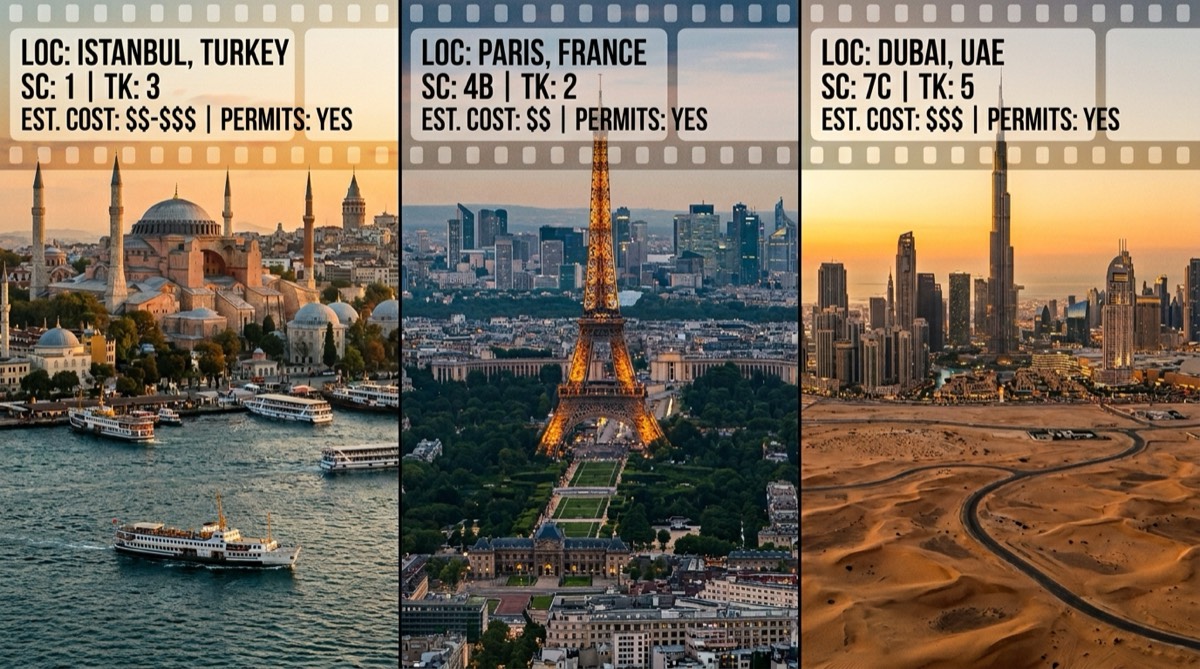
When a production company sends you a budget, looking at the Excel spreadsheet and thinking "where do these numbers come from?" is a completely normal reaction. Commercial budgets cover dozens of line items, each with its own logic. Here's a breakdown of every major one.
Main budget categories
Above the Line (ATL) — Creative crew
This covers director, director of photography (DoP), and line producer fees. Usually calculated on a daily rate basis. For a mid-budget production in Turkey, the combined daily cost of these three can start at a few thousand dollars; internationally sourced directors or DoPs push that number significantly higher.
Below the Line (BTL) — Technical crew and equipment
Camera crew, lighting crew, sound crew, art department, costume, makeup, production assistants — plus equipment rental (camera, lenses, lights, vehicles). On larger productions, a strong line producer is essential to keep this category under control.
Location
Location costs vary enormously. A villa or retail space in Istanbul might run a few hundred dollars per day, while a historic site or a shoot requiring road closures can multiply that several times over. Transportation, parking, and generator rental should be included in location estimates.
Cast
Casting agency commission + talent day rates + usage fee. Usage fees are frequently overlooked but can multiply an actor's base rate depending on broadcast duration and channel. Social media use requires separate usage fee negotiation from broadcast rights.
Post-production
Edit, color grade, sound design, music, and VFX or motion graphics if applicable. Post can account for 20–35% of total budget. "We'll fix it in post" almost never works — what gets missed on set costs more to address in the edit suite.
Production company markup
Production companies typically add 15–25% on top of direct costs. This covers management, coordination, insurance, and overhead. In a transparent budget this line item appears separately.
Questions to ask when reviewing a budget
- Are taxes included in these figures?
- Are usage fees included?
- Is there an overtime buffer?
- What are the cancellation/postponement terms?
- How many rounds of post-production revisions does this cover?
Red flags
If you see any of the following, ask more questions:
- A single line item labeled "production cost" with no breakdown
- Post-production missing entirely or listed as a token amount
- Usage fee absent or marked "included" with no scope defined
- No overtime buffer at all
A good budget shows clearly where every dollar goes. Transparency isn't just honesty — it's a sign of professionalism.
Above the Line vs Below the Line
A professional production budget divides costs into "above the line" (creative talent: director, producer, lead cast) and "below the line" (technical and operational execution: crew, equipment, locations, catering, post-production, insurance). Understanding this split helps you evaluate where budget is being allocated and why. A technically complex multi-location shoot has a large, detailed below-the-line. A director-driven creative project may prioritise above-the-line talent.
Key Line Items Explained
Pre-production: Location scouts, casting, permit applications, technical scouts. Usually two to four weeks of coordinator time for a standard TVC.
Production days: All crew wages, equipment rental, location fees, catering, transport, and on-set consumables. The largest single section of a commercial production budget.
Post-production: Edit, colour grade, sound design, music licensing, and delivery. For a 30-second TVC, typically two to four weeks depending on VFX complexity and revision rounds.
Contingency: Standard practice is five to ten percent of total costs. Covers permit delays, weather holds, cast illness, and scope additions. Unspent contingency is returned to the client with full reconciliation.
Insurance: Should cover equipment, public liability, errors and omissions, and cast coverage. Confirm the schedule covers your shoot locations and equipment values.
Red Flags in a Production Quote
Vague line items without detail, missing contingency, production fees buried in inflated equipment rates, permit costs listed as a single lump sum, and equipment rates that combine rental with operator without a breakdown — all indicate a budget likely to generate surprises during production.