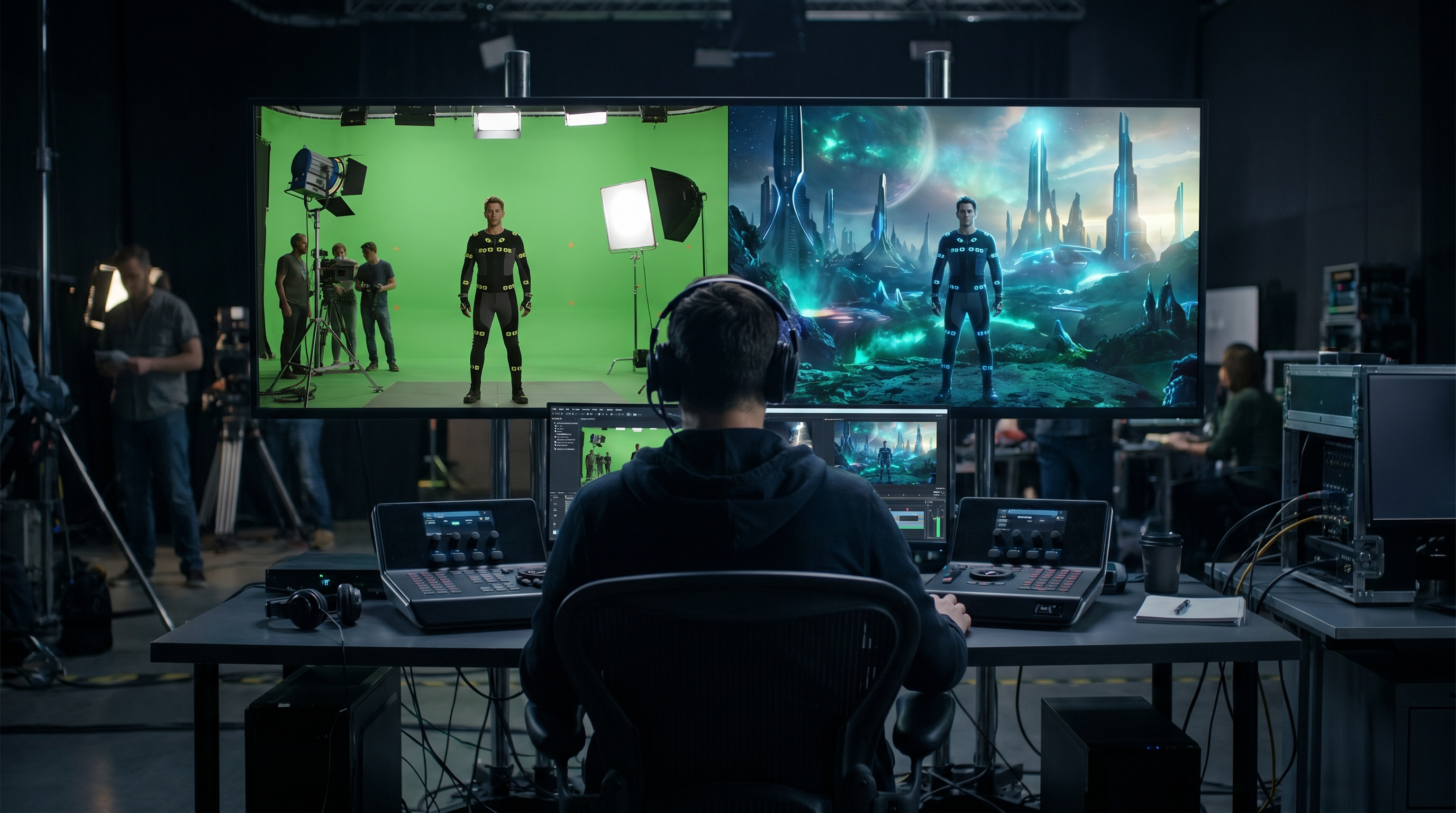
The conversation about AI in production often defaults to a binary: are you doing it with AI, or are you doing it for real? This framing misses where most of the interesting work is actually happening. The hybrid workflow — live-action camera footage combined with AI-generated or AI-enhanced elements — is increasingly how practical productions control costs while expanding what's creatively possible.
What hybrid production actually means
In a hybrid workflow, the camera still rolls. Talent is real. Performance is real. But the world around the talent — or specific elements within it — are created or extended using AI tools. A performer shot against a simple background. An environment generated or extended in post. A product interaction that would have required an expensive practical rig, replaced with a composited AI element.
This is not new as a concept — VFX compositing has existed for decades. What's changed is the accessibility, speed, and cost. What previously required a large VFX house and a significant budget now has accessible tooling that can be integrated into a standard post-production pipeline.
Where AI compositing adds the most value
Environment extension
Shooting in a real location but needing a sky replacement, a background extension, or a different time of day. AI-powered tools can replace and extend environments with high realism at a fraction of the cost of building or finding the perfect practical location.
Product visualization
A product that doesn't physically exist yet, or exists in a form that isn't photogenic, can be composited into live-action footage. The talent interacts with a stand-in; the product is replaced in post. For tech products, pharmaceuticals, and some FMCG categories this is standard practice.
Crowd and scale
Scenes that imply large crowds, vast spaces, or epic scale — expensive or logistically impossible to produce practically — become achievable by compositing AI-generated crowd or environment elements into live-action footage.
Difficult practical elements
Water, fire, weather, specific lighting conditions that couldn't be achieved on the shoot day. AI compositing allows these elements to be added or enhanced in post without a reshoot.
The workflow in practice
Planning for hybrid production starts in pre-production, not post. The director and VFX supervisor need to agree on which elements are live and which are composited before the shoot. This determines how scenes are lit, how the camera moves, and what markers or reference elements need to be captured on set.
A hybrid production that hasn't been planned in advance — where the decision to composite an element is made after the shoot — costs significantly more and usually produces worse results. The camera needs to have been in the right place, with the right lighting reference, for the composite to work.
What hybrid production is not
It is not a cheap replacement for everything. The performance at the centre of a hybrid production is still a live-action performance, with all the costs that entails. The value is in extending what that performance lives inside — expanding the world without expanding the shoot.
It also requires specific post-production expertise. Not every edit house or colour grade facility has compositing capability. Build the post-production team with hybrid workflow in mind, not after the fact.