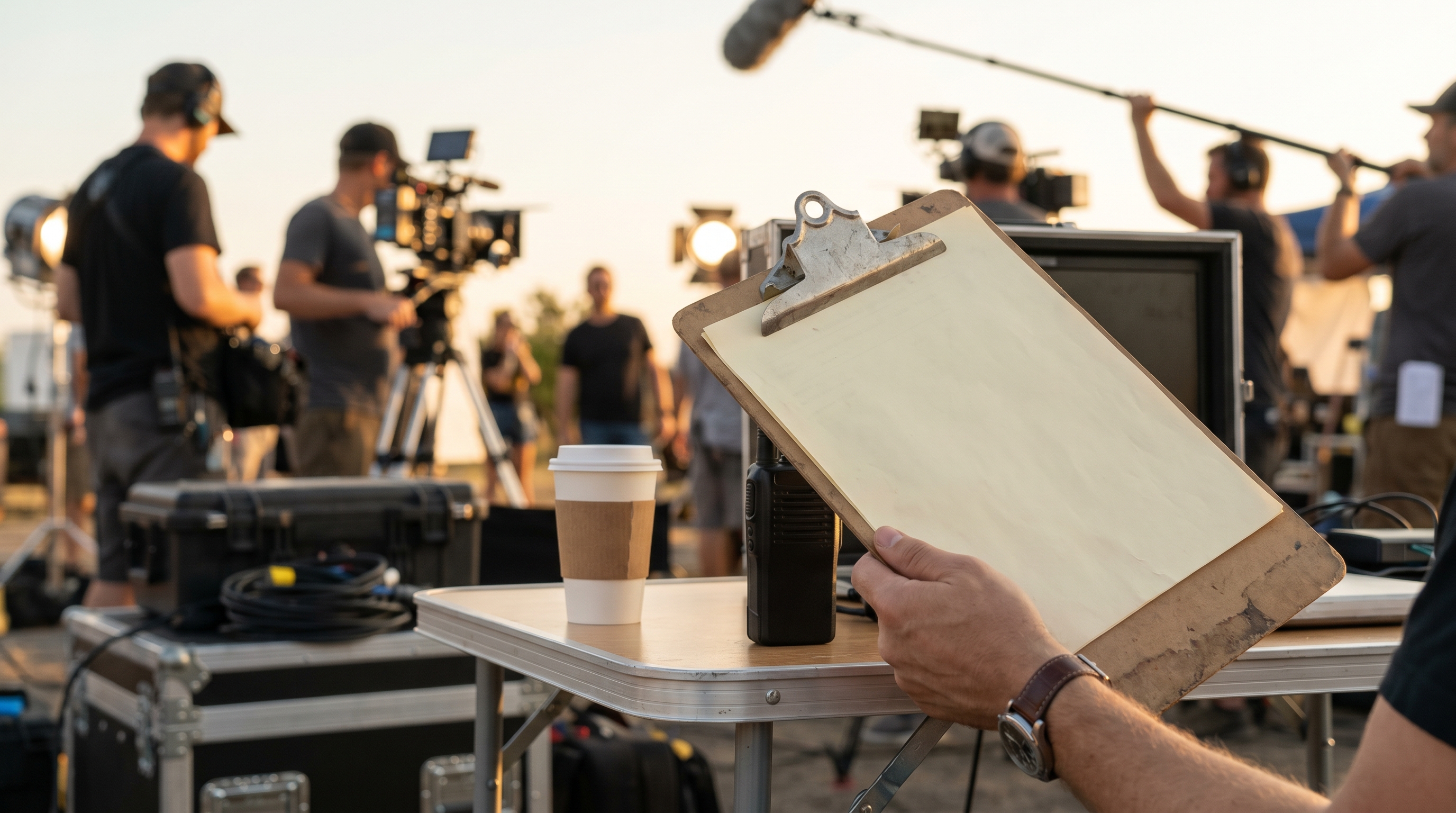
A call sheet is the map for a shoot day. It tells everyone on crew who needs to be where, at what time, for what purpose. It covers the shooting order, location details, cast call times, emergency contacts, and catering schedule. It goes out no later than 24 hours before the shoot.
This sounds straightforward. It is not always executed that way.
What a call sheet must contain
- Project info: Project name, client, shoot date, and which day of the shoot this is (e.g., "Day 1 of 2").
- General call time: The baseline time for crew arrival. Individual departments have their own call times relative to this.
- Location details: Full address, specific entrance instructions, parking information, and a map link. Not just a street name.
- Shooting order: Which scenes are being shot in what sequence. Organized by production logic, not script order.
- Cast information: Which talent is in which scene, their set call time, and their hair/makeup call time (these are different).
- Crew list: Each department, the person responsible, and their phone number.
- Equipment notes: If there is a crane, a special vehicle, a generator, or any other large equipment, when and where it arrives.
- Meal breaks: Breakfast, lunch, dinner. This is not optional information. Crews that do not know when they eat lose focus.
- Weather: For exterior shoots, the forecast and a brief note on contingency if needed.
- Emergency contacts: Production coordinator, director, line producer, and location manager — all on one page.
Who prepares it?
Usually the production coordinator or the 1st AD. The director and line producer do a final review. The agency producer should receive it as a matter of course before the shoot day.
What a bad call sheet does to a shoot day
On one shoot, the location address on the call sheet was missing the entrance gate information for a large complex with multiple access points. Part of the lighting crew went to the wrong entrance, could not reach anyone by phone, and arrived 45 minutes late. That 45 minutes became a cost — equipment rental running, cast waiting, crew on the clock. The fix now is simple: every address on our call sheets comes with a Google Maps pin.
Another failure mode: the shooting order is updated verbally the night before, but the call sheet is not revised and reissued. The actor in the first scene arrives at makeup at the time listed on the old version, which is now not their scene. Thirty minutes lost before the day has properly started.
Digital or printed?
Both. PDF to the production WhatsApp group is standard. But key crew members should have a printed copy. When signal is weak, or a phone battery dies on a location without power, paper is what works. This sounds overly cautious until the first time you are on a remote exterior shoot and realize no one on set can pull up the call sheet on their phone.