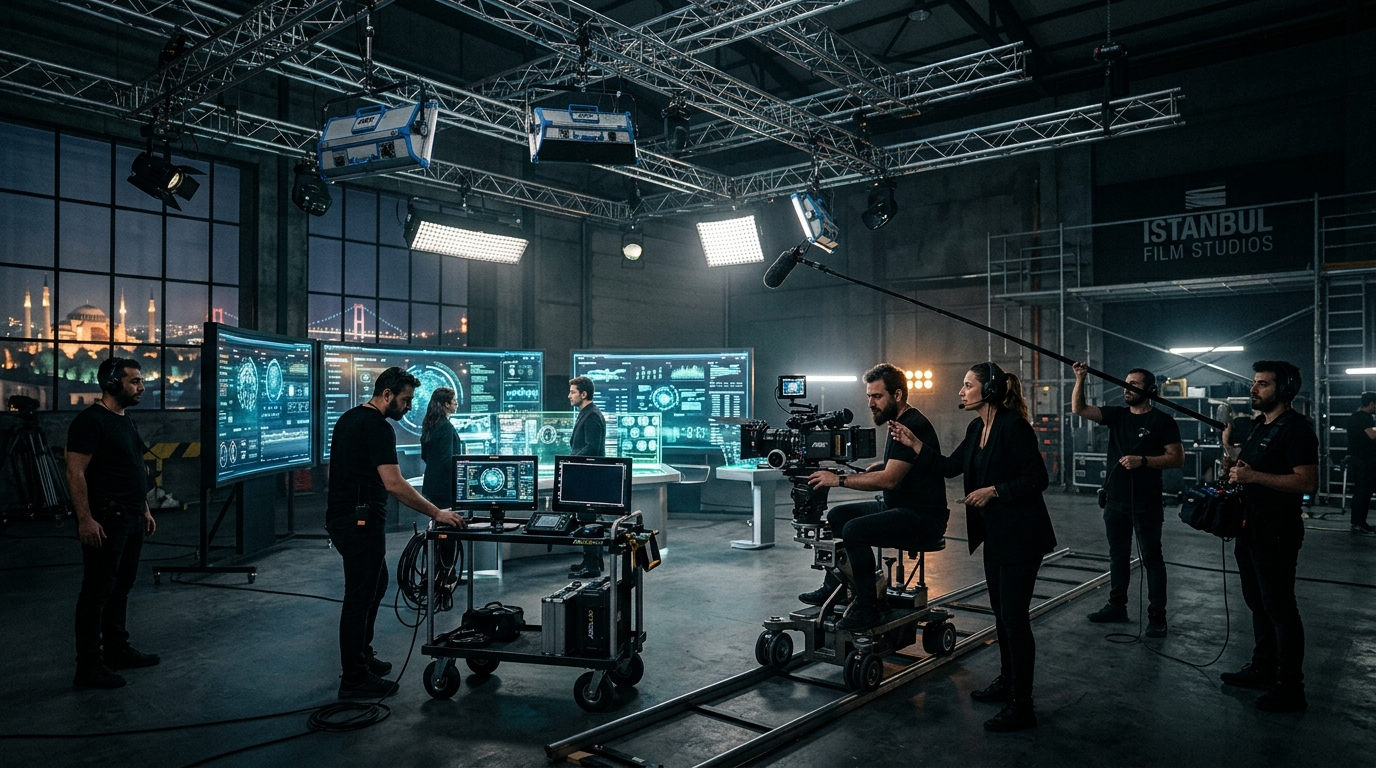
Where AI production breaks from the classic campaign flow
A classic campaign moves linearly from brief to set: concept, casting, location, shoot, post. AI production cuts into that order. At the concept stage you don't hand the client words. You hand them visuals. What you show is not a moodboard, but reference frames that already look very close to the campaign's real shots. That shortens approval cycles in a real way. At PAM Istanbul we lean on this most for time-critical product launches.
Here is the concrete difference. A classic flow for a 30-second TVC takes six weeks. A hybrid flow can deliver the same campaign in three weeks — but it has a cost. Decision time shrinks, the client has to decide faster, and the internal approval loop has to be disciplined. You gain speed; you don't gain chaos. That distinction matters.
Stage 1 — brief and concept (AI moodboard)
The work starts with the brand brief. We read it and put three directions on the table within 24 hours. Midjourney V7 and Gemini 2.5 Pro work side by side here. Midjourney for aesthetic direction, Gemini for reference fidelity and text integration. Each direction comes as a concept package of 6 to 8 images: main key visual, alternate composition, color palette reference, atmosphere examples.
What gets decided at this stage is the campaign's tone. If you tell a brand "minimal Scandinavian," the generated visuals explain that better than words can. When the client says "yes, this one," every later stage builds on that direction.
Stage 2 — pre-prod: storyboard, casting, location
After concept approval, pre-prod begins. AI sits inside it, but classic pre-prod doesn't go away. We generate the storyboard frame by frame in Midjourney and revise it with the director. Casting runs the classic way — if we use real actors, we do real casting. Location scouting now happens AI-first: the imagined location is generated in AI, then our team finds the real counterpart in Istanbul. That cuts scouting time in half.
Stage 3 — capture/production: real vs AI split
This is the decision moment. Which frame comes from a real set, which one from AI generation? The call rests on three questions: (a) Is a human face and micro-expression critical in the frame? Yes — real set. (b) Is the product a real, touchable object whose definition relies on light and reflection? Yes — real set, then AI for multiplication. (c) Is the scene a hard-to-reach or expensive environment (Mars surface, futuristic city, exaggerated atmosphere)? Yes — AI.
A practical example: a perfume campaign. The model's face, the perfume bottle, and her hand — those come from a real set. The desert backdrop, the surreal atmosphere, the scale shifts — those come from AI. Sora 2 and Runway Gen-4 handle motion shots here; Midjourney and Gemini handle stills.
Stage 4 — post-prod and format delivery
Post-prod still leans on classic tools. Premiere, DaVinci, After Effects. But AI inpainting comes in before color for scene extension or background swaps. Magnific runs 4K-8K upscales, print gets a 300 DPI output. One discipline we keep: AI-generated frames always live in a separate folder under a separate naming scheme. We document, in the deliverables, which frames are AI and which are real.
Delivery formats: broadcast master for TVC (Apple ProRes 422 HQ), H.264 in multiple durations for digital (30s, 15s, 6s), square and 9:16 vertical cuts for social, CMYK 300 DPI TIFF for print. Producing 40 to 60 different outputs from a single AI campaign has become standard.
Stage 5 — quality control and brand consistency
Consistency is the hardest part of AI. When you generate six frames for one campaign, brand identity can drift. We close that gap with three tools. LoRA models train a brand-specific visual signature — product, palette, typical composition. A master prompt document gets shared across the team so the work isn't left to one person's "creativity." A QC checklist runs against every frame for color profile, typography placement, logo clarity, and brand conflicts.
The risk of dismantling a brand identity built over years inside a single AI week is real. We don't overplay that risk and we don't underplay it. Every image we deliver gets a manual check against the brand guideline.
Stage 6 — approval loop and revisions
In a classic campaign the revision loop runs in hours or days; if a re-shoot is needed, in weeks. On the AI side, we deliver revisions in 30 minutes. That speed is also the danger — the feeling that "anything can change" can dilute decision-making. So we cap approval rounds: maximum three revision rounds, anything beyond that becomes a separate scope. That rule protects the client and protects us.
Stage 7 — how to start a campaign with PAM Istanbul
Step one is the discovery call. In 30 minutes we cover the brief, target audience, campaign timeline, and which channels we'll produce for. Step two: within 48 hours, you get a direction proposal — three concepts with visual references. Step three: the work starts. We have over eight years of campaign history; in the last two years our hybrid AI production team has worked with brands like Cartier, Mercedes-Benz, Nike, and Pierre Cardin. We built a structure that thinks fast but produces with discipline.
Let's build this together.
Whether it's a single campaign or a year-long production partnership, we bring the same playbook that works for Cartier, Mercedes-Benz, Nike and Pierre Cardin. We mentor your team as we deliver — transparent process, documented AI decisions, no black boxes.
Email: [email protected]
Phone: +90 530 267 49 29
Studio: Yayıncılar Sok. 10/3, Seyrantepe · Istanbul