What is actually in the package?
A standard product photography package has four core layers. The first is white background: the clean, isolated frame that fits e-commerce listings. It usually covers 3 to 5 angles (front, side, top, detail, base label). The second is angle variation: the same product turned through 360 degrees or shot from 8 fixed angles, which lifts online conversion significantly for categories like shoes, bags, and jewelry.
The third is lifestyle: the product framed in its natural use environment, with a model or with props. These frames feed social media, landing pages, and campaign visuals. The fourth is detail macro: textures, stitching, close-ups of materials. For premium brands these are the frames that carry the product's story. The texture of a perfume bottle's glass, the dial detail of a watch, the leather grain on a bag.
The package mix changes by brand. Mass-market e-commerce usually leans heavily on white background, while luxury brands invest in lifestyle and macro. At PAM we set this mix together at the brief stage.
What the brand needs to bring
Two things matter before shoot day: sample count and brief clarity. On samples a practical rule applies: every product to be shot needs at least 2 good copies. One for the main capture, one as backup. Brands that arrive with a single sample stretch the shoot day if a piece gets smudged or damaged. That affects both the delivery schedule and the crew planning.
On the brief, four items are enough: target audience (age, interests, buying behavior), reference visuals (at least 5 examples, ideally from competitors and from work they love), placement (Amazon, Instagram, the website, print catalog), and brand style guide (color palette, tone, banned visual elements). Brands that share these four in writing move much faster on shoot day.
Shoot flow: studio day step by step
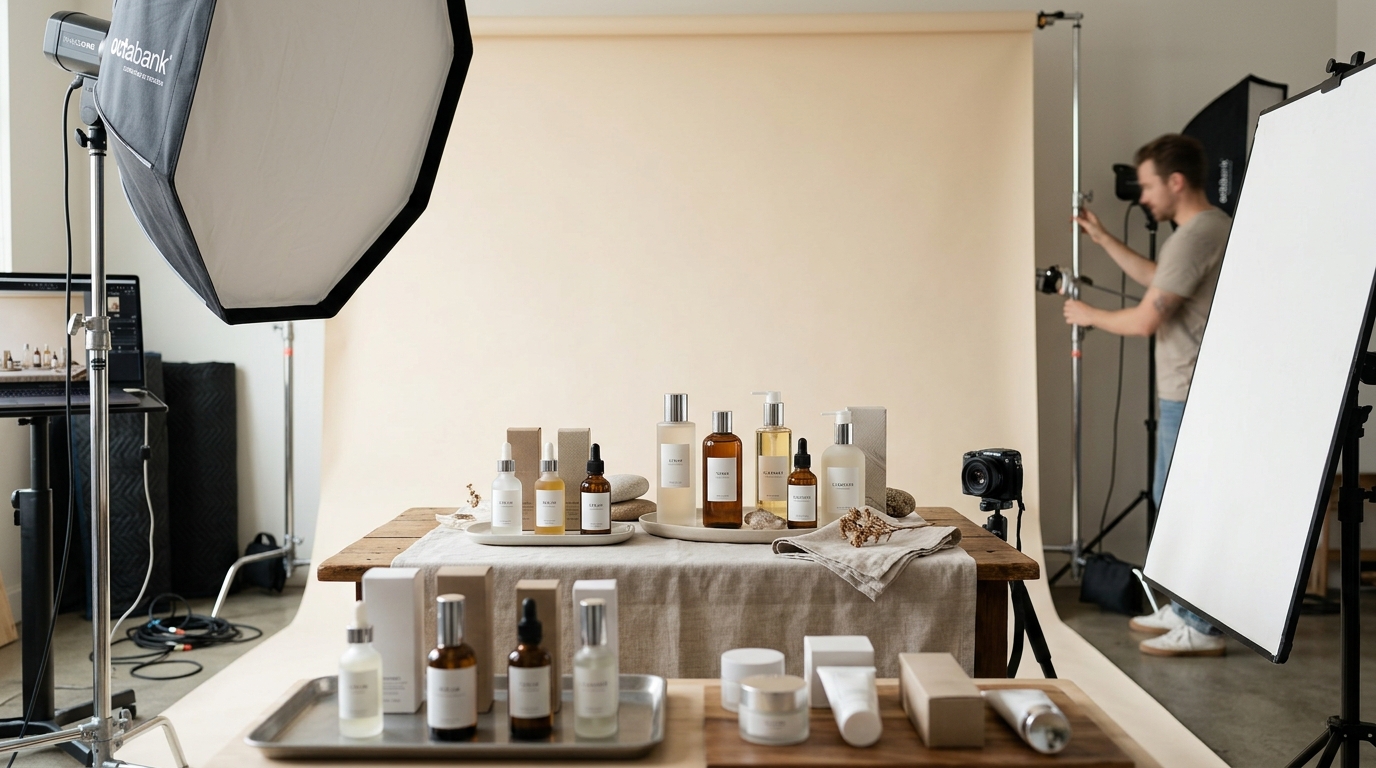
A typical studio day runs like this. Morning is product intake and prep: items are cleaned, labels checked, brought to display condition. When the prep is weak, hours are lost in post, which is why the first hour of set is an expensive hour. Lighting setup and test frames follow: the key angle gets balanced, white-background reflection is checked, the reference frame is sent for approval.
After approval, the main shoot begins. White-background frames usually go in the morning, lifestyle and macro in the afternoon (as the light softens, lifestyle reads more naturally). During the shoot, a brand representative can be on set, or we share frames live and take feedback in real time. That cuts revision needs significantly.
At the end of the day, raw frames are gathered, a pre-selection is made, and proof images are sent to the client within 24 hours. The proof stage is a critical step in the overall turnaround of the package.
What affects delivery time?
The main drivers of turnaround: product count, variation count, revision rounds, and format variety. Typical ranges look like this. 5 to 10 products, white-background heavy: 5 to 7 working days from shoot to delivery. 10 to 25 products, mixed white and lifestyle: 10 to 14 working days. Lifestyle-heavy campaign package with model and location: 3 to 4 weeks. These are not fixed numbers and shift with brief complexity.
What stretches the timeline most: late samples, brief changes, extra revision rounds, extra format requests (square, vertical, horizontal, heart-shape crop, grey-background version, and so on). On that list the "extra format" is the sneakiest, because the brief often opens with "square for Instagram is enough" and ends in delivery week with "should we also pull a vertical for Pinterest." We see it often.
How revisions are managed
A well-run revision process ends in three rounds. Round one: selection on the proof frames and the large change notes (e.g., "use angle two instead of frame three, warm up the background a touch"). Round two: fine adjustments on processed frames (color, contrast, local retouches). Round three: final approval and delivery formatting.
Reaching a fourth round usually points to a gap in the original brief. It happens, but if it repeats, the process needs to be reset. At PAM the first three rounds are included in the package, and we keep written notes on what changed in any extra round so the brief template gets updated for next time.
Hybrid approach: where AI variation enters
We shoot the product's real frames in the studio, then produce background and seasonal variations with AI. One studio frame for a cosmetic product can turn into five scenes: white background, marble surface, wood surface, beach atmosphere, snow atmosphere. The product stays accurate and variation work moves from days to hours. That matters most for seasonal campaigns.
The limit: AI variation does not work at the same quality for every product. Transparent glass, metallic surfaces, and very fine textures still trip up AI tools. We separate these at the brief stage, deciding which frames belong on a real set and which can be multiplied with AI.
How to start with PAM Istanbul
The first step is a discovery call. We listen to product count, target market, and placement channels. We then come back with a tailored proposal: which frames go on white, which lifestyle, how many angles, how many variations, whether hybrid AI fits. Once the brief is clear, the shoot day and the delivery schedule are planned within a week.
Whether it is a single campaign or an annual catalog shoot, the same process applies: a clear brief, a planned set, three revision rounds, a documented delivery. To start the conversation, write to us.
Let's build this together.
Whether it is a single campaign or a year-long production partnership, we bring the same playbook. Transparent process, documented decisions, no black boxes.
Email: [email protected]
Phone: +90 530 267 49 29
Studio: Yayıncılar Sok. 10/3, Seyrantepe · Istanbul