Why catalog photography is different from a brand campaign
For a brand campaign you make 6 to 10 hero frames and spend days on each one. A catalog is the opposite: 500 to 2,000 SKUs, minutes per frame. That is a different discipline. The point isn't creativity, it's pace; not speed, but consistency. The same T-shirt has to appear in eight colors with the same pose, same light, same crop. If one SKU drifts in light or angle from another, the customer feels it on the product page; it reads as "third-party."
On the e-commerce side there are also marketplace rules. Trendyol, Hepsiburada, Amazon — each has its own white background, resolution, and ratio specs. Re-preparing a single catalog for four different marketplaces in a classic flow is a waste of time and money. AI comes in here through a disciplined hybrid workflow.
Hybrid flow: reference shoot plus AI variation at scale
Our flow runs like this. One day in the studio for the reference shoot: one master frame per product, with proper light and a calibrated color profile. Then the AI side kicks in. Color variations come from AI — navy, gray, and burgundy derivatives of a black T-shirt are generated through Gemini 2.5 with reference fidelity. Angle variations work the same way — 3/4 and side views built from the front-shot master. Lifestyle scenes come from Midjourney and Sora 2 showing the product on a model or in context.
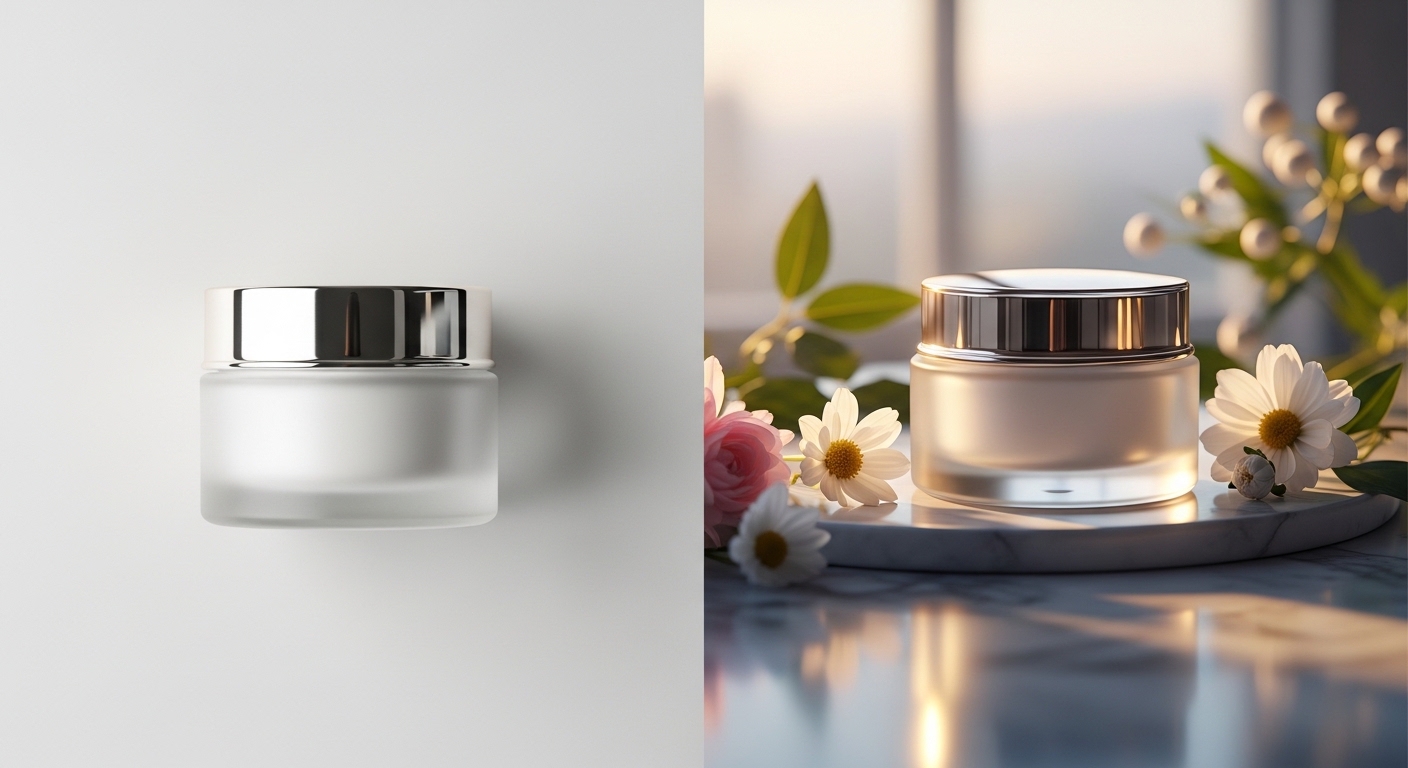
One point matters here: this flow runs well for textiles, but AI's reference fidelity isn't yet enough for shiny or reflective surfaces (glass bottles, metallic packaging, jewelry). Those products still need real capture for each variation. We decide by category.
Marketplace technical requirements
Quick summary of what each marketplace asks for. Trendyol: 1200x1800 px minimum, white background (RGB 255,255,255), no shadow, product fills 85% of the frame. Hepsiburada: 1500x1500 square, white background, JPEG. Amazon: 2000x2000 minimum, pure white background, product at 85% of the frame, controlled shadows. Trendyol Crossborder (international): again 2000+ px, but some categories require an additional lifestyle image.
To enforce these rules inside AI generation we built a batch processing flow. The master prompt holds fixed technical constraints like "white background RGB 255,255,255, no shadow, product 85% of frame, 2000x2000." Even then, every output has to pass manual QC; AI sometimes lands at 84% or 87% product fill, and algorithmic checks reject it.
Brand consistency: LoRA, master prompt, QC checklist
In a 500-SKU catalog the biggest risk is drift. If the light tone shifts between SKU 1 and SKU 487, the customer notices the difference moving between product pages. We close that gap in three layers. LoRA model: a custom model trained on the brand's reference shots; light tone, composition, and white balance are locked. Master prompt: a shared document of the common technical constraints used across all SKUs. QC checklist: color profile, product crop, shadow, product-fill ratio, file size.
Without that discipline AI catalog photography looks fast but quality collapses by SKU 200. With discipline, quality holds.
How 500 SKUs get done in a day
In practice the work runs like this. Day 1 — reference shoot: 6 to 8 studio hours capture master frames for every product group, 2 to 3 examples per group. Day 2 — AI variation: batch processing through Gemini and Midjourney; 50 to 100 images queued at once. The master prompt stays fixed, only SKU variables move. Day 3 — QC and rework: manual review, re-generating broken outputs, converting to marketplace formats.
So "in a day" is a marketing claim; in reality this is a disciplined three-day flow. Against a classic studio flow, three days instead of three weeks for 500 SKUs — that difference is real and sustainable.
Variation strategy for social and A/B testing
An extra benefit on the AI side of catalog work: producing social and A/B test variations alongside the marketplace image. Showing the same product in five different backgrounds and three different lifestyle scenes, then running performance tests on Meta and Google Ads. In a classic flow that means five separate shoots; in a hybrid AI flow 30 variations come out of the master frame in minutes.
What the brands we work with want to see in the first 30 days is usually this: which lifestyle scene drives the highest CTR? Being able to test that quickly is the real value AI adds to catalog work.
How PAM Istanbul works with e-commerce clients
We start with a pilot on a slice of the catalog — 20 to 30 SKUs. We show both the flow and the quality. After pilot approval we move to the full catalog. We set up the marketplace technical rules; your product team only supplies the master list. Textile, accessories, cosmetics, food — we adjust the approach to the category. We are open about AI's current limits on glass and metallic products; being honest about that keeps the working relationship solid.
Let's build this together.
Whether it's a single campaign or a year-long production partnership, we bring the same playbook that works for Cartier, Mercedes-Benz, Nike and Pierre Cardin. We mentor your team as we deliver — transparent process, documented AI decisions, no black boxes.
Email: [email protected]
Phone: +90 530 267 49 29
Studio: Yayıncılar Sok. 10/3, Seyrantepe · Istanbul