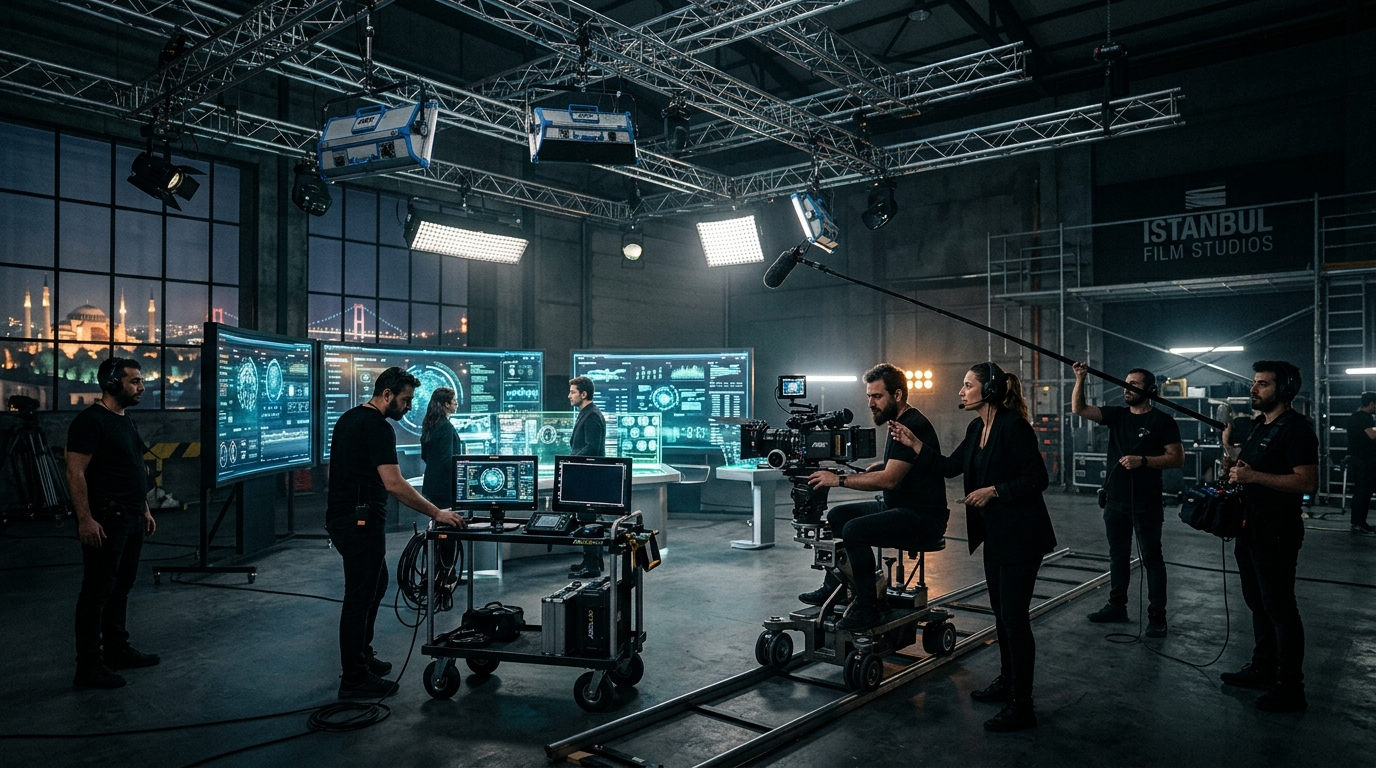
What does "AI commercial shoot" really mean?
Three different things can be meant. The first is a fully AI-generated film: you write prompts in Sora, Veo or Kling and pull out a 30-second commercial. Fast, cheap, and often handy for urgent social-media pushes. The second is real footage plus AI post: you shoot with a camera, then handle background swaps, scene extensions, digital product placement with AI. The third, and the most realistic for most brands, is the hybrid model. AI runs at the brief, concept and variation stage; the real set covers the frames where brand safety can't be compromised.
Which one you pick depends on where the ad is going to live. For TV and cinema, where broadcast quality and live performance matter, full AI is still risky. On Instagram, TikTok and YouTube Shorts, AI is much more comfortable. What gets sold to a brand as an "AI commercial" usually rides on the hybrid model, and getting that clear at the start is half of the client-agency conversation.
Where AI starts and stops in the brief-to-launch flow
AI starts the moment the brief lands. Read a two-page brief from the client, draft three creative directions — Midjourney or Gemini handles that in an afternoon. We used to spend three days on moodboards. Storyboard is next. An illustrator used to be on standby for sketches; now we deliver 30 frames in half a day through Midjourney V7. The client sees the frames and picks a direction, so the conversation is much cleaner before the set goes up.
The set itself is still largely traditional. Director, cast, lighting crew, camera department — AI doesn't replace those, at least not at broadcast quality. AI re-enters in post: background replacement, sky updates, digital product placement, and in some cases voice adaptation for lip-sync. Format adaptation right before launch — turning a 16:9 spot into 9:16 and 1:1 — is much faster with AI.
The three stages where AI is strong
1. Concept and moodboards. Showing three directions to a brand inside 24-48 hours is a real client-relationship advantage. This used to take a week, and the client got impatient in the gap. Now there are three different worlds on the table two days after the brief lands.
2. Variation generation. When the same commercial needs to adapt to different markets, AI shines. The same scene, different models, different language placements, different palettes — one post cycle yields 10-15 variants.
3. Format adaptation. Turning one spot into vertical Reels, horizontal YouTube, square feed, and story formats is no longer manual work. AI handles smart reframing — the important elements land inside the frame. This used to cost the team days.
Where AI alone isn't enough
Live performance is the first limit. A real actor's emotion, micro-expressions, vocal nuance — AI can mimic them, but it still doesn't feel "real." A campaign with a brand face, a social-purpose ad, a customer testimonial: real human, real set.
Brand safety is the second limit. When AI generates a scene, it may not hold your product in exactly the right form. A logo can come back at the wrong proportion, a packaging color can shift, a product shape can drift slightly. For automotive, luxury goods, pharmaceuticals, that isn't acceptable. In those categories the set is non-negotiable.
Broadcast quality is the third limit. TV broadcast standards (color space, frame rate, audio standards) still demand the classic production pipeline. AI output is fine for digital but needs extra layers for a TV master. For cinema spots the gap is wider.
Hybrid: when real set and AI meet
In the hybrid model work flows like this: creative direction and storyboard with AI, set and acting traditional, post partly AI partly classic. The client doesn't see the three layers — for them it's a single film. The trick is naming which layer does which job at the brief stage.
A practical example: on a recent cosmetics campaign we shot the product macro takes on a real set. Texture and color fidelity were critical. The lifestyle scenes (breakfast table, bathroom mirror) were AI. The model's face close-ups went back to live shooting. The whole job wrapped in 14 days; on a fully classic flow it would have taken 4-6 weeks.
Five questions brands ask most
"Can we produce the whole spot with AI?" Technically yes, by brand risk profile usually no. For quick social content maybe, for the main campaign risky.
"Are AI outputs safe on rights and licensing?" You have to check the commercial terms of the tool you use. Midjourney Pro and above, Gemini are commercial-cleared; some open-source models are problematic. The contract needs to draw that line.
"Can you produce without our director?" Possible, but inconsistent. The director's decisions show up inside the AI prompts; the role doesn't disappear, it shifts.
"Can we expand the campaign later?" This is the strongest part of the hybrid model. Adapting a campaign to 30 countries, 12 languages, 6 formats no longer takes a month.
"What if AI shows our product wrong?" That's exactly why we go hybrid. Every frame where the product reads as critical is either a real shoot or AI output that goes through tight QA.
The PAM Istanbul approach
We don't force one model. We read the brief and build the model the brief requires. Some jobs land at 80% AI, 20% set; others run the other way. At every stage the client knows which layer comes from where. AI decisions are documented — which tool, which prompt, which version is in the delivery file. That transparency makes the brand's internal approval cycles much easier.
Let's set up a discovery call for your first project. We talk through the channel the ad lives on, your brand's risk profile, and the calendar pressure, and decide together which model fits you.
Let's build this together.
Whether it's a single campaign or a year-long production partnership, we bring the same playbook that works for Cartier, Mercedes-Benz, Nike and Pierre Cardin. We mentor your team as we deliver — transparent process, documented AI decisions, no black boxes.
Email: [email protected]
Phone: +90 530 267 49 29
Studio: Yayıncılar Sok. 10/3, Seyrantepe · Istanbul