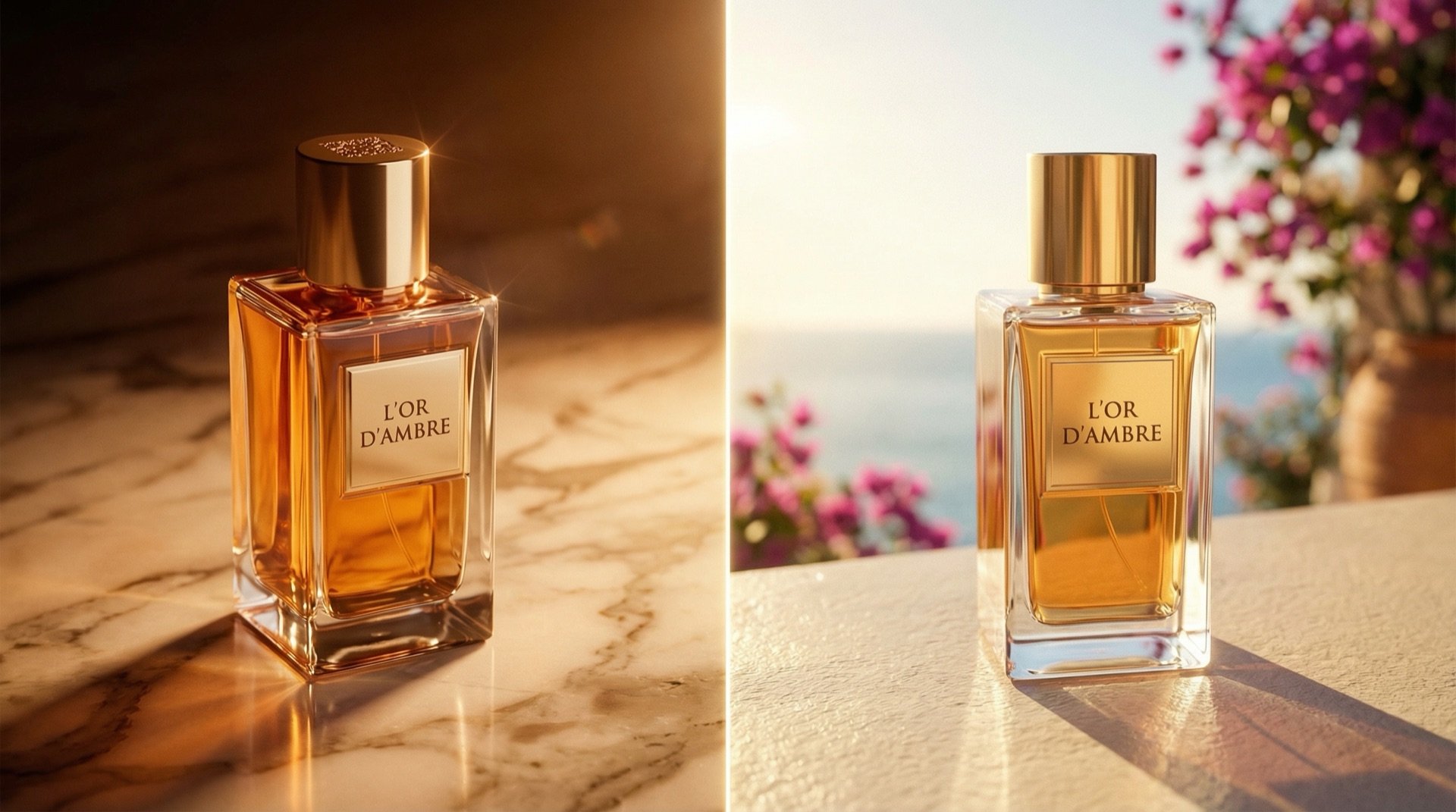
Can AI replace the studio shoot? When does it deliver, when does it fall apart, and what's the right posture for a brand that takes its image seriously? Those are the only questions worth answering.
This is a grounded map of AI product photography in 2026 — the wins, the limits, and the workflow that actually ships catalogue at scale without gutting the brand.
What AI Product Photography Actually Is
AI product photography is the use of generative models to create, edit, or rebuild product imagery from scratch. In practice it splits into three disciplines:
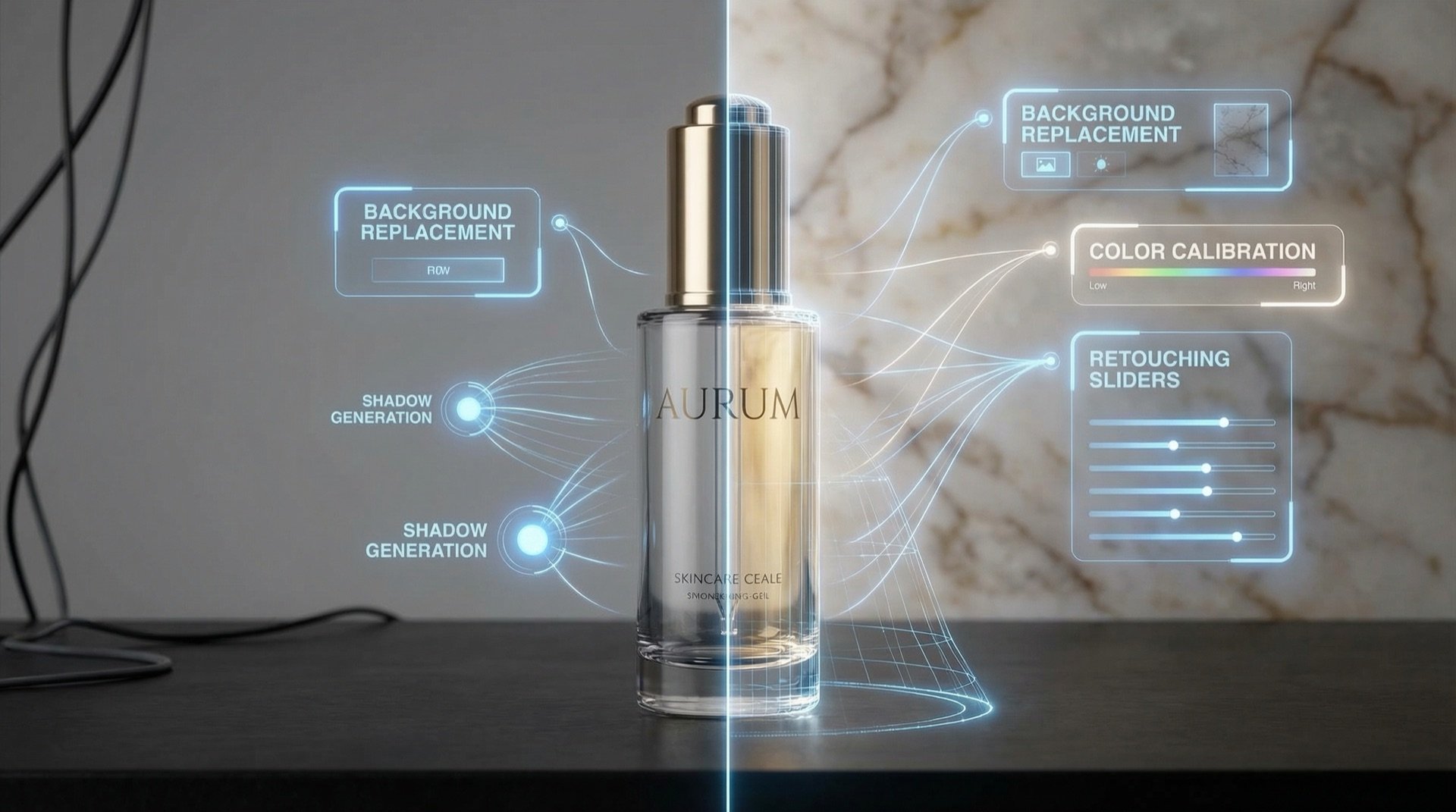
1. Background replacement
Lifting a product off a white sweep and dropping it into a lifestyle environment. The most common entry point — seconds per frame, usable results at e-commerce scale.
2. Image enhancement
Relighting, shadow synthesis, colour calibration, automated retouching. Compresses a post-production pass from hours to minutes without losing frame-level control.
3. Full synthetic generation
Building imagery from a 3D model or reference set — no camera involved. The most powerful tier, and the one that punishes teams without visual direction experience.
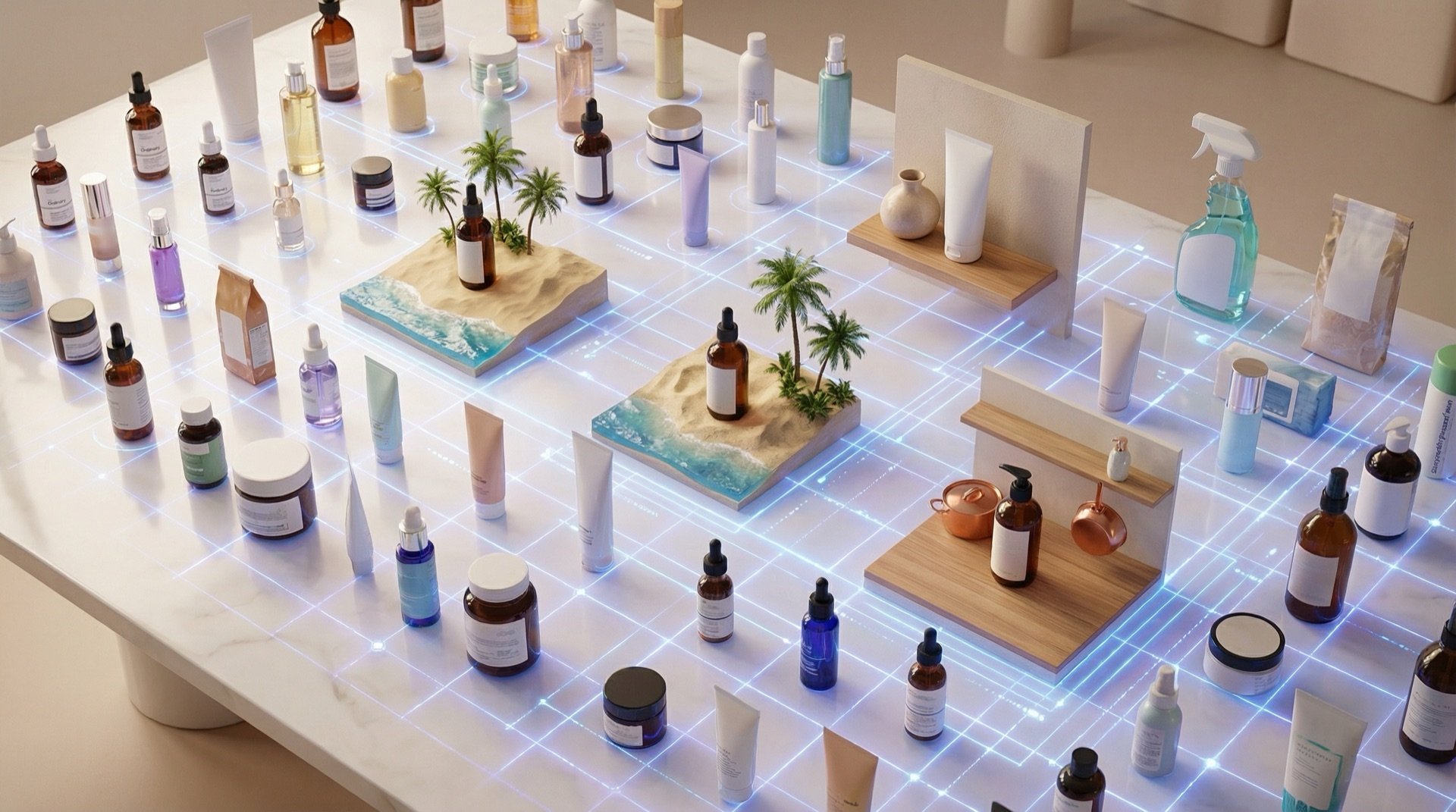
Why the conversation got loud in 2026
The numbers are unambiguous:
- Searches for "AI product photography" are up 50% year-over-year
- Generative image software grew 441% in 2024 — the fastest-growing software category on the market
- 14% of e-commerce companies already run AI-assisted imaging tools in production
- Brands using AI product imagery report sales lifts of up to 20% within 90 days
The underlying truth is simpler than the hype: e-commerce brands ship hundreds of SKUs a week. Traditional studio workflows don't scale to that cadence without hemorrhaging budget.
When AI delivers — and when it doesn't
Where it works:
- Large-catalogue e-commerce imagery across hundreds of SKUs
- Seasonal background swaps (summer, winter, holiday concepts)
- A/B variants for paid and on-site testing
- Rapid social adaptations across aspect ratios
- Visualising prototypes before production samples exist
- First visual set for a lean, early-stage brand
Where it breaks:
- Luxury campaign imagery, where texture, light and atmosphere carry the brand
- Food and gastronomy — AI still can't make steam rise or sauce pour convincingly
- Fashion lookbooks, where fabric behaviour, expression and movement matter
- Technical product detail — precision hardware, interior structure, material truth
- Brands launching a new visual identity that needs an original language first
Hybrid production: where the real answer lives
The industry's biggest mistake is treating AI and studio as rivals. The sharpest results come from hybrid production — fusing the aesthetic memory of a real set with the speed and scale of generative models.
How hybrid production works
Stage 1 — Aesthetic DNA on set
A professional shoot establishes the brand's visual grammar: lighting design, palette, composition logic. This becomes the brand's visual DNA.
Stage 2 — Encoding the DNA into the model
That grammar is translated into a reference set the model can learn from. With 10–15 well-directed frames, generative output starts holding the brand tone consistently.
Stage 3 — Scaling
Hundreds of frames, produced fast, all aligned to the original studio standard. Catalogue, social, regional variants — all coherent.
Stage 4 — Human control
Every frame is reviewed by a trained eye. The things AI still misses — shadow direction, colour temperature, the weight of a composition — get resolved by hand.
How PAM Istanbul runs hybrid
Since 2018 PAM Istanbul has produced work for Pierre Cardin, Cartier, Realme, Xiaomi, Nivea, San Pellegrino and others. The aesthetic memory built on those sets is the foundation of PAM AI-LAB.
Inside AI-LAB, generative models aren't an automation shortcut — they're a discipline for extending the aesthetic memory we built on set:
- Fashion and campaign: Pierre Cardin and Armine taught us to translate fabric behaviour and model presence into the digital layer
- Gastronomy: San Pellegrino and Tamek sharpened the mathematics of heat, steam and appetite on a plate
- Technology and automotive: Suzuki, MG Cars, Realme and Xiaomi set our precision standards for hardware imagery
- Luxury and architecture: Cartier, Galataport and Kuwait Airport honed how light carries narrative into the frame
That experience is the one advantage AI-native studios can't replicate: aesthetic memory earned on real sets.
The tools actually worth running
There are dozens of platforms. These are the ones holding up in commercial production:
Background replacement and retouching
- Photoroom — built for e-commerce, fast background swaps
- Adobe Firefly — integrated into the Adobe stack, commercially licensed
- Canva AI — accessible for lightweight edits
Full generative imagery
- Midjourney — highest aesthetic ceiling, strong for fashion and luxury
- Stable Diffusion — open source, customisable, with product-focused fine-tunes
- DALL-E 3 — excellent prompt fidelity, responds to detailed direction
Video and motion
- Runway Gen-4 — the most mature product-video generator
- Sora — cinematic quality for product films
- Veo — Google's video engine, with e-commerce hooks
The real variable: no tool replaces prompt engineering and visual direction. Knowing how to operate a model is nothing like knowing how to produce brand-grade imagery with it.
Rights and regulation in 2026
What to track this year:
- The EU AI Act enters full force in August 2026, introducing transparency requirements for AI-generated commercial imagery
- C2PA — a provenance metadata standard being adopted by major platforms
- Commercial licensing — Midjourney, Adobe Firefly and DALL-E 3 are cleared for commercial use; Stable Diffusion depends on the specific model licence
- Derivative risk — models "inspired by" other brands' imagery create real legal exposure
Practical rule: don't publish AI imagery for a serious brand without a trained review pass. The reputational downside of an IP dispute far outweighs the production saving.
A five-step roadmap
Step 1 — Audit your image inventory
Which SKUs actually need new imagery? Which of those are well-suited to AI generation?
Step 2 — Define the visual standard
Palette, lighting approach, composition rules. This becomes the brief every model and every operator answers to.
Step 3 — Pilot small
Run 10–20 products through the workflow. Compare against studio references. Capture feedback before scaling.
Step 4 — Design the hybrid pipeline
Decide exactly which tasks the model owns and which stay with humans. Document it.
Step 5 — Bring in a production partner
Running AI tools solo is possible. Running them to brand standard, at scale, with consistent output — that's where a studio partner changes the economics.
The takeaway
AI product photography has passed the "should we use it?" phase. The real question is "how do we use it properly?"
AI alone produces images that are technically correct and emotionally flat. Traditional shoots alone produce beautiful work that can't keep up with a modern catalogue.
The answer sits in the middle: hybrid production. Aesthetic memory earned on real sets, scaled through generative speed.
Work with PAM AI-LAB
PAM Istanbul has been producing commercial imagery for Turkey's most demanding brands since 2018. The aesthetic memory from more than 500 completed projects now runs through PAM AI-LAB.
Need AI-assisted product imagery that still reads as your brand?
- Reach out for a no-cost scoping call
- We'll map how your existing imagery can scale through AI without losing identity
Contact: [email protected] · +90 530 267 49 29 · Yayıncılar Sok. 10/3, Seyrantepe · Istanbul
FAQ
Is AI-generated product imagery cleared for commercial use?
Yes — Midjourney, Adobe Firefly and DALL-E 3 offer commercial licensing. Under the EU AI Act, transparency obligations are rising, so professional review is non-negotiable.
How long does AI product photography take?
A single image can be generated in minutes. Producing a consistent, brand-aligned catalogue — including prompt development and QC — takes one to five working days.
Can studio photography and AI be combined?
Yes, and it's the most effective model. Hybrid production pairs the depth of a real shoot with the speed of generative output. PAM AI-LAB runs on exactly this model.
What does AI product photography cost?
AI-only services run roughly ₺10–100 per image. Professional hybrid production sits between ₺200–1,500 per image — typically 60–80% below traditional studio rates for comparable output.
Produced by the PAM Istanbul AI-LAB team. Last updated March 2026.