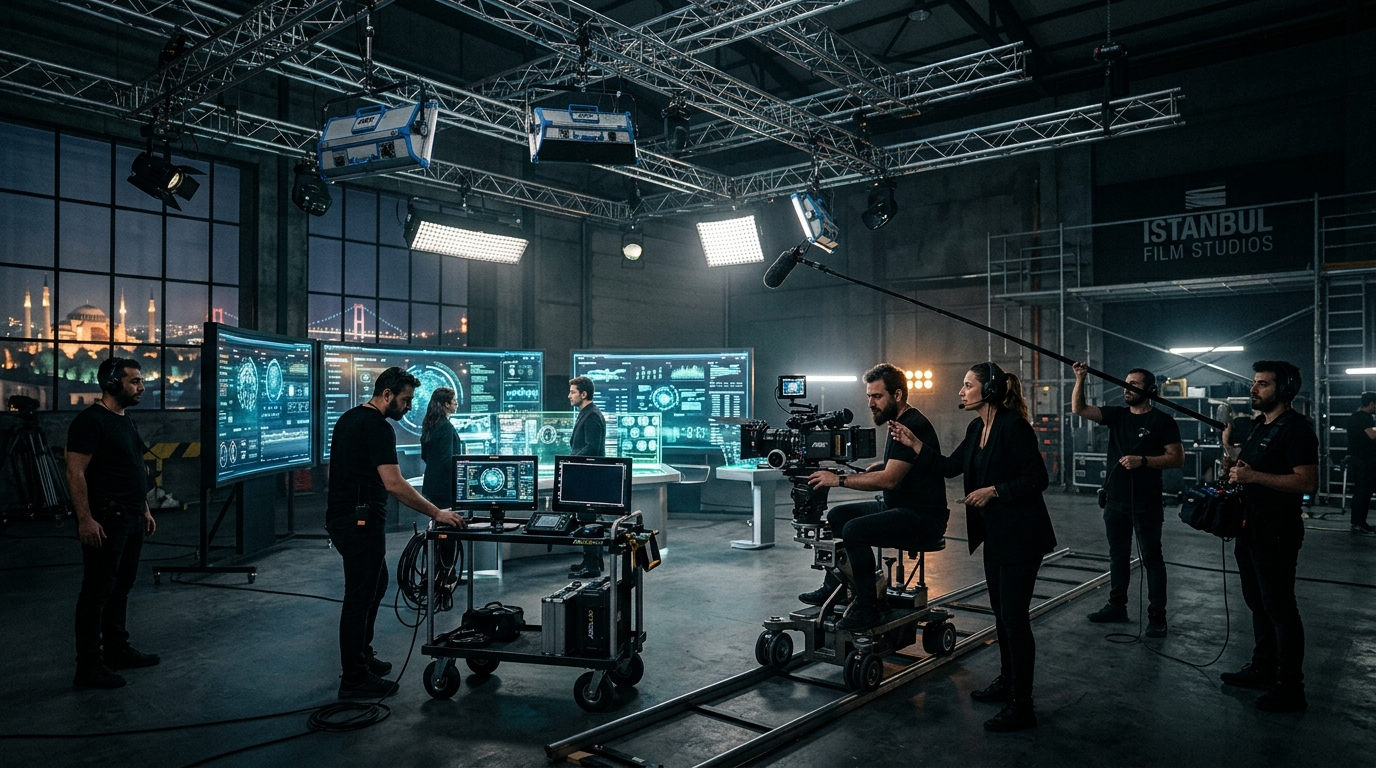
Why an AI agency is a different conversation from a traditional one
A traditional production agency runs crew, gear, and set. An AI production agency does all of that plus model selection, prompt engineering, workflow integration, and rights risk management. The difference is not just one extra tool in the kit. When AI enters the workflow, everything shifts, from how the brief is read to how the final files are delivered. A campaign that used to be about three hero shots is now about thirty variations. Feedback loops get shorter, and quality-control load gets heavier.
The practical takeaway: if you are asking an agency "do you also use AI," you are probably asking the wrong question. The right one is "at which point in the process, with which models, and through which approval steps do you use AI." How clearly they answer tells you a lot about the shop.
What to look for in the portfolio
First signal: real client work. If an agency's site shows "AI-generated examples" with no client name attached, those are most likely internal tests. The gap between a test and a delivery is wide. A prompt can produce a clean test result, but can it carry a campaign that runs for weeks? You only know that from work that was actually delivered.
Second signal: is the AI's role visible? A good AI agency shows case studies with a transparent breakdown, something like "the background was generated in Midjourney, the product was shot in studio, the composite was assembled in Photoshop." Black-box presentations are the most reliable sign that there will be trouble later.
Third signal: tool variety. An agency that only uses Midjourney is like someone trying to solve every job with a hammer. Midjourney is strong on editorial aesthetics, Gemini on reference fidelity, Firefly on commercial-rights safety, Flux on photographic realism. Portfolios that show multiple models point to teams who can match the right tool to the right job.
Hybrid workflow: where AI starts, where the shoot ends
Fully AI-generated campaigns are possible, but for most brands the hybrid workflow gives the most reliable output. On a PAM set, the product and the talent typically come from a real shoot, and the backgrounds and set extensions come from AI. That combination keeps the product accurate, brings set costs down, and speeds up variation production.
The question to ask is when the decision is made. If you start working with an agency and it is unclear how the choice between "all AI, all set, or hybrid" gets made, you will be surprised throughout the process. Solid teams put that decision on the table at the brief stage, alongside budget and timeline.
Rights and usage
License terms on AI tools keep moving. Midjourney, Gemini, and Firefly each have their own positions on commercial use, training data, and output ownership. Managing the risk on the brand side is the agency's job. Firefly currently offers the cleanest commercial license structure because it is trained on Adobe Stock. Midjourney V7 can be used under its commercial plan, but there are still open lawsuits about training data. A good agency explains this at the brief stage and justifies why a given model was picked.
One clause to look for in the contract: "all generated visuals' rights are transferred to the brand, and the license terms of the AI models used are documented as an attachment." An agency that avoids writing that sentence will leave you alone if a problem comes up later.
Process transparency: four signs of a black-box agency
First: they will not give a clear answer to "which model did you use." They call it a trade secret. The actual trade secret is the prompt structure, not the model name. Second: surprise costs appear in revision rounds. The cost structure of AI production is very low per revision, so agencies that itemize revisions as extras need to be asked about their cost model.
Third: delivery formats are vague. The native resolution of AI output is usually not enough for print. The agency should be clear from the start about which upscaling tool will solve that. Fourth: raw files are not delivered. If PSDs, prompt logs, and reference images are not shared, the brand has to start from scratch when it moves to a different agency for the next campaign.
Six critical questions to ask
- Which models do you use on a commercial plan, and why?
- At which step of the process will you bring AI into this project?
- Will the contract transfer the rights of the generated visuals to us?
- How many revision rounds are included, and how long does an extra round take?
- Does the delivery package include prompt logs, raw files, and layered PSDs?
- Have you delivered work in our sector before, and for whom?
An agency that handles these six questions easily is probably a good partner. Teams that hedge or say "we'll talk about that later" tend to create problems down the line.
The PAM Istanbul approach
We have been integrating AI into the production workflow since 2023. The discipline we bring to Cartier, Mercedes-Benz, Nike and Pierre Cardin shows up in our AI work too. On every project, the reasoning behind each model choice is documented, raw files are shared with the brand, and rights are transferred by contract. The set crew and the AI Studio team work off the same brief, which keeps the hybrid flow from becoming a surprise.
Whether a campaign should be fully AI, fully on set, or hybrid depends on the project. We put that question on the table at the brief stage and answer it together. Budget and timeline get built around that decision, not the other way around.
Let's talk and build the right workflow together
Which model fits your campaign can usually be settled in a 30-minute discovery call. We want to listen first: who the brand is, who the audience is, what the campaign has to do. From there we decide hybrid, full AI, or full set, together.
Let's build this together.
Whether it is a single campaign or a year-long production partnership, we bring the same playbook. Transparent process, documented decisions, no black boxes.
Email: [email protected]
Phone: +90 530 267 49 29
Studio: Yayıncılar Sok. 10/3, Seyrantepe · Istanbul