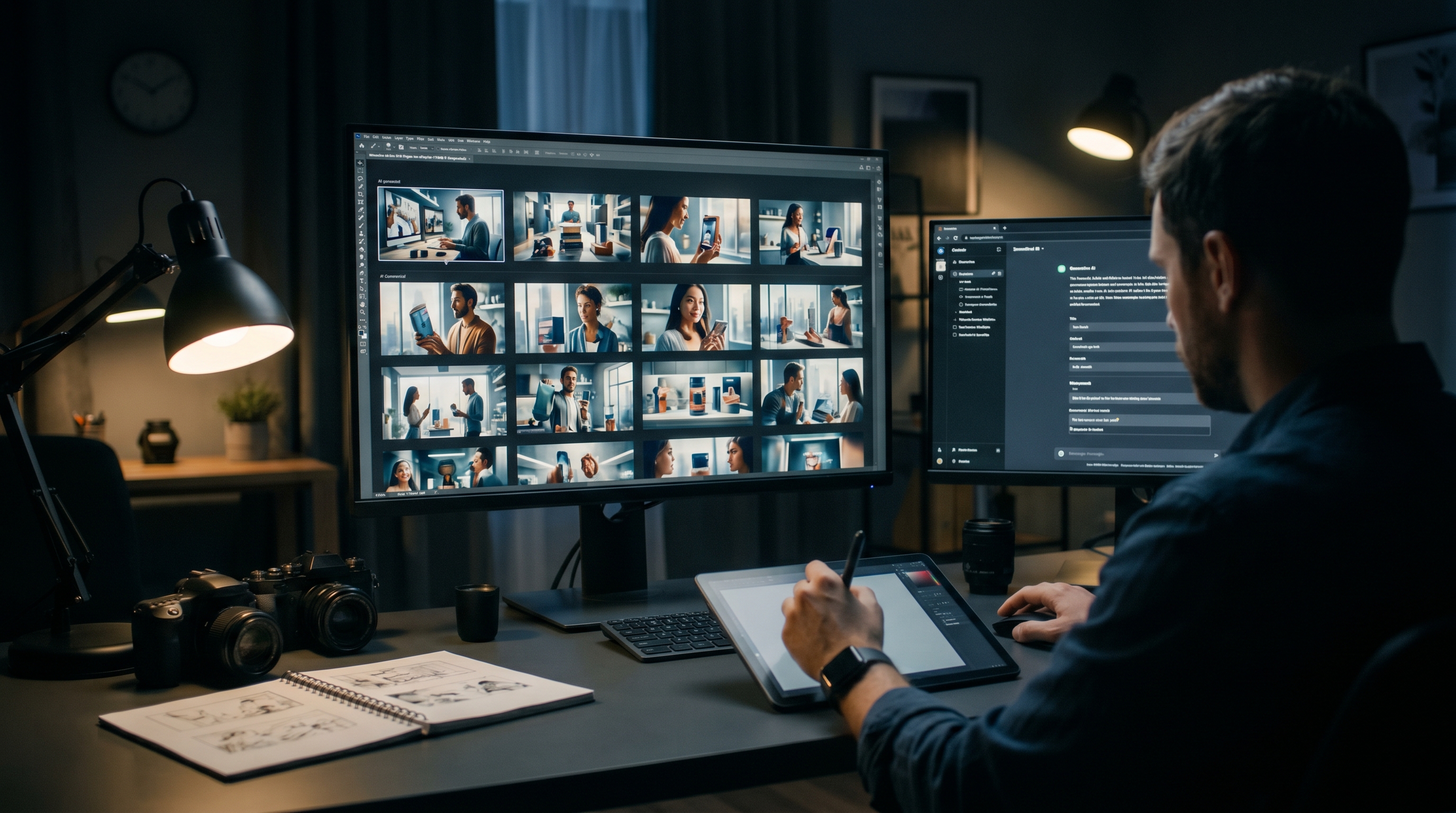
Storyboarding has always been the gap between what the brief describes and what the shoot delivers. A hand-drawn storyboard communicates intent; it rarely communicates feel. AI image generation has changed this. A director or producer who knows how to use Midjourney or Stable Diffusion can now produce storyboard frames that communicate lighting mood, colour palette, and compositional approach in a way that pencil sketches never could.
What changes and what does not
What changes: the time from brief to visual reference, and the level of specificity those references can carry. What does not change: the need for a human to know what they are trying to show. AI amplifies creative intent — it does not generate it. A vague prompt produces a vague image.
The most effective AI storyboards come from directors or producers who have already resolved the visual language of the film in their head. The AI tool is then used to externalise that internal vision quickly and at low cost.
Midjourney for storyboards
Midjourney\'s strength is aesthetic coherence. Its outputs have a consistent visual quality that makes individual frames feel like they belong to the same world. For directors who need to communicate a specific mood or colour palette to a client or agency, Midjourney-generated frames are often more persuasive than anything drawn by hand.
The challenge is control. Midjourney is probabilistic — you describe what you want and get something close, but exact compositional control requires iteration and sometimes technical prompting workarounds. For storyboarding purposes this is usually acceptable; you are communicating feeling, not framing to the millimetre.
Stable Diffusion for style consistency
If you need multiple frames to share a consistent character — same actor\'s face, same set, same lighting setup across different shots — Stable Diffusion with ControlNet or similar extensions gives you structural control that Midjourney does not. This is particularly useful for creating boards that show coverage: wide, medium, and close-up versions of the same scene.
The learning curve is steeper, but the output is more controllable. For productions where the storyboard will be used in client presentations where visual consistency matters, this additional effort pays off.
From brief to first boards in under an hour
A realistic workflow: the brief arrives, the creative team identifies three to five key scenes that define the film. Each scene is prompted in Midjourney with mood, lighting, and compositional references. The first batch of results takes fifteen minutes. Refinement and selection take another thirty. The result is a set of frames that can anchor a treatment discussion or pre-production conversation before any traditional pre-production work has begun.
This compresses what used to be a multi-day process — brief → concept discussion → storyboard commission → artist turnaround → client review — into the same afternoon.