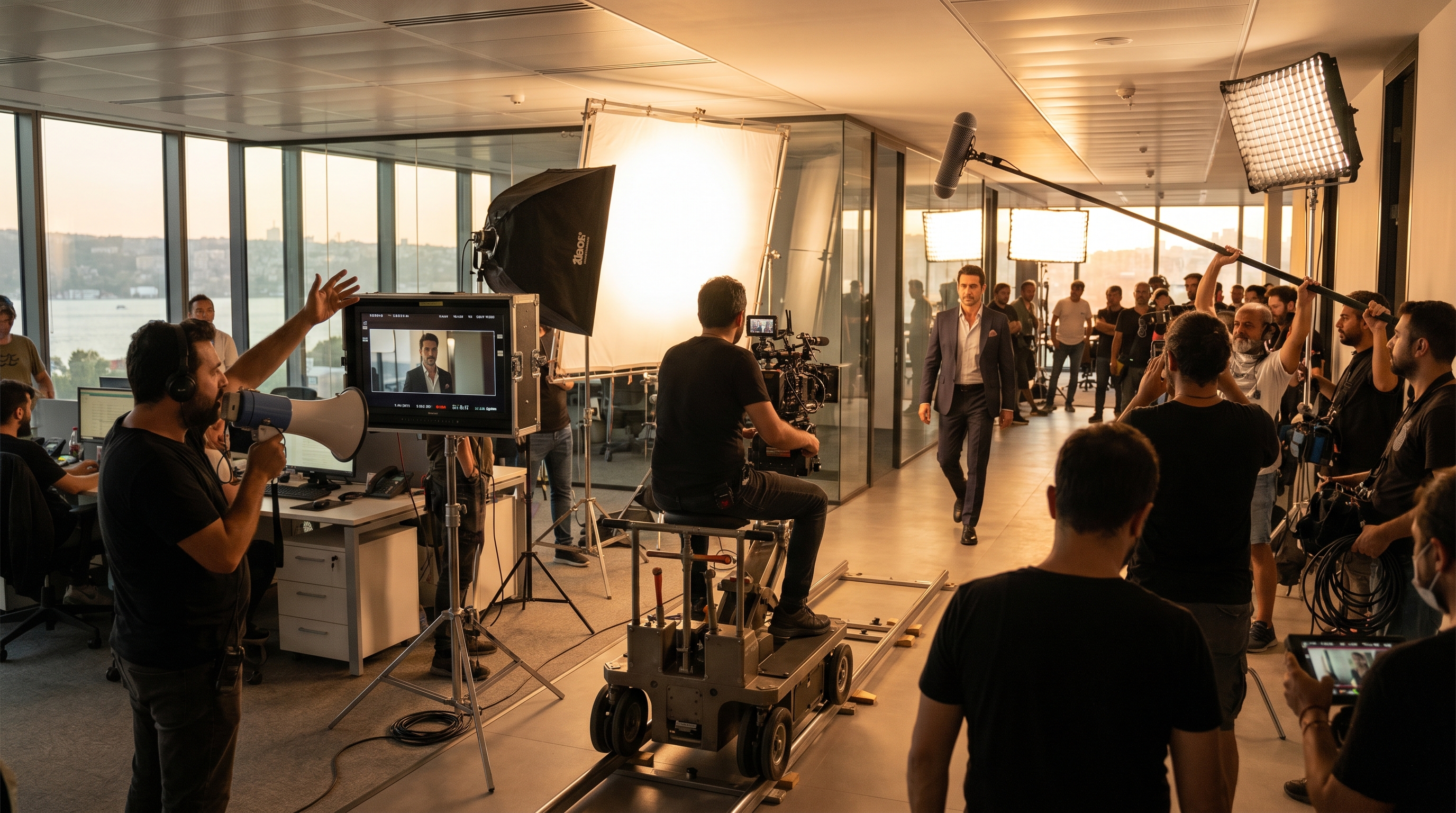
Most people on the client side experience a TVC as a finished film that arrives, gets approved or revised, and eventually airs. The production process that sits between brief and broadcast is largely invisible. This article makes it visible — phase by phase, with realistic timelines.
Understanding how a commercial is made is not a technical curiosity. It changes how you write briefs, how you set expectations, and how you handle the moments when something goes wrong. Because something always goes wrong.
Phase 1: The brief and agency strategy (1–2 weeks)
Before any production company sees the project, the agency and client work through the strategic brief. What is the film trying to say? Who is it speaking to? What should a viewer feel or do after watching it? These questions seem simple but routinely take longer than expected to resolve.
A weak brief at this stage is the most expensive mistake in TVC production. It will not be corrected by a good director or a talented editor. It will simply travel through every subsequent phase and create problems that compound.
Phase 2: Creative development and treatments (2–3 weeks)
Once the brief is approved, the creative team develops scripts and concepts. These are then sent to directors — typically two or three — for treatment responses. A treatment is the director's written interpretation of how they would make the film: visual approach, tone, casting thoughts, references, production ideas.
Reading treatments well is a skill. The best treatment is not the longest or the most beautifully designed — it is the one that proves the director has genuinely understood the brief and has a specific, executable vision for it.
Phase 3: Pre-production (3–4 weeks)
Once a director is selected, pre-production begins. This is the most complex phase in terms of coordination. Location scouting, casting, set design, wardrobe, crew assembly, equipment booking, permit applications — all of these run in parallel under the supervision of the producer and production manager.
A pre-production meeting (PPM) brings together agency, client, and production company to align on every creative and logistical decision before the shoot. What happens in the PPM determines what happens on set. Leaving the PPM with open questions is always a risk.
Phase 4: The shoot (1–3 days typically)
Shoot days are the most visible and most expensive days in production. A full crew — camera, lighting, sound, art department, hair and makeup, catering, transport — is on set, burning budget by the hour. The director's job is to get the coverage needed; the producer's job is to protect the schedule.
Overruns happen. Sets are unpredictable, weather turns, performances take time. The decisions made about what to cut, what to carry over, and what to solve in post happen in real time and require both creative judgment and financial awareness.
Phase 5: Post-production (3–6 weeks)
Offline edit, colour grade, sound design, music, voice-over, visual effects, online mastering — post-production is its own project within a project. Each round of client and agency feedback adds time. The most common delay in post is not the technical work; it is the time between submission and client response.
A well-structured approval process with clear deadlines for each round reduces post timelines significantly. An unstructured one can stretch a three-week edit into two months.
Total timeline: what to expect
A typical mid-budget TVC from brief approval to delivery runs eight to twelve weeks. Fast-track projects can compress this to five or six weeks, but something always gives — either the creative quality, the budget, or the team's wellbeing. Understanding what the process actually contains makes it easier to decide consciously what to protect and what to compromise.