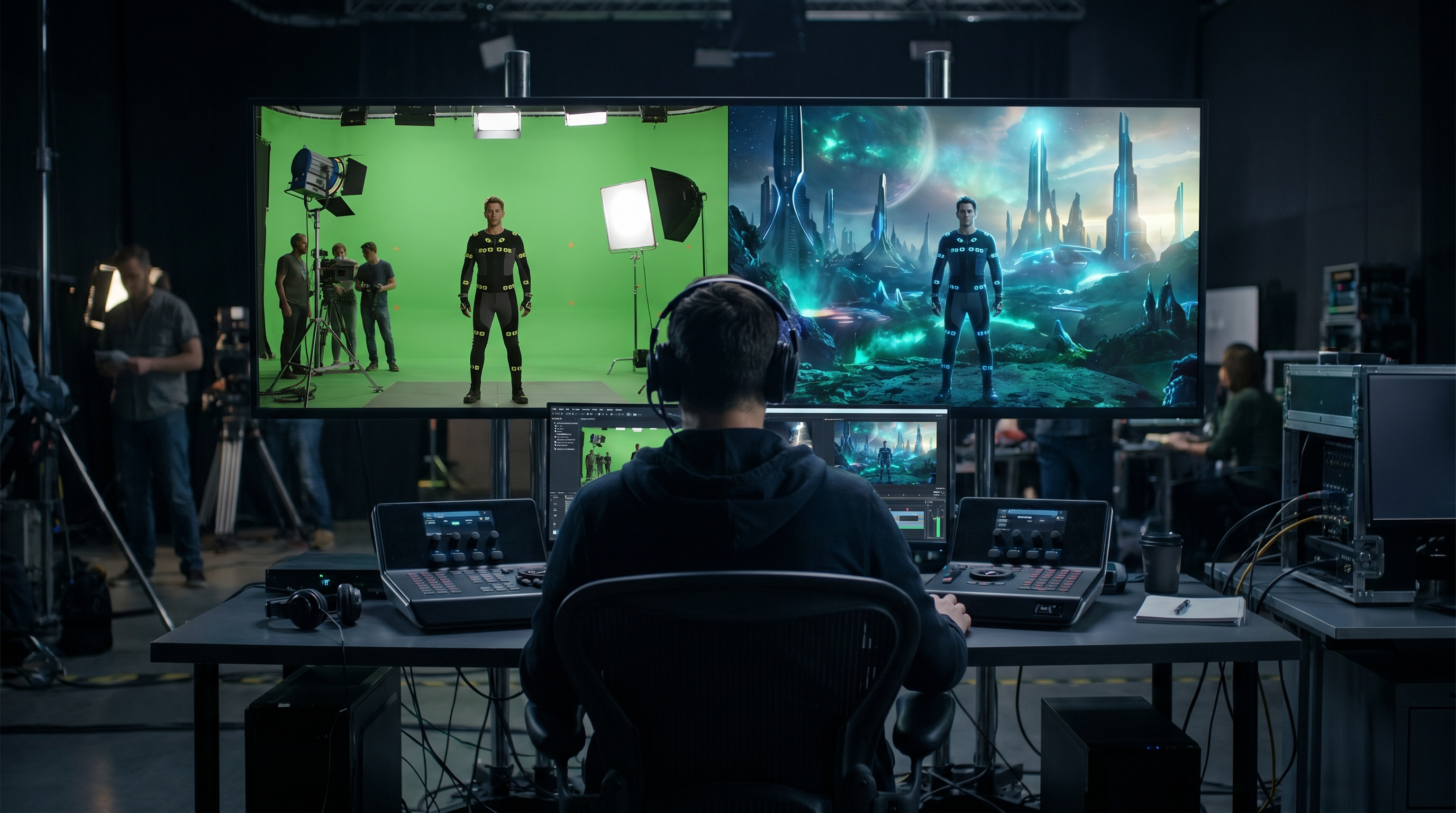
Every production now faces the same question at some point in pre-production: which of these scenes actually need to be shot on camera, and which could be handled — in whole or in part — by AI generation? The answer is not always obvious, and the stakes are real in both directions. Shooting something unnecessarily is expensive; trying to generate something AI cannot deliver reliably is expensive in a different way.
The decision framework
Start with what each approach does well. Live action is strong where human presence, physical performance, and tactile authenticity matter. A close-up of a person\'s face, a product being handled, a physical interaction between people — these are difficult for current AI tools to handle with the reliability and quality that commercial production requires.
AI generation is strong where environments, scale, and visual complexity are the main requirement — and where the specific details are less critical than the overall impression. A futuristic cityscape, an abstract data visualization, a sweeping landscape that would require helicopter access in traditional production: these are candidates for AI generation or AI-enhanced composition.
Hybrid workflows in practice
The most common hybrid approach is live-action foreground with AI-generated or AI-enhanced background. Talent is shot against a neutral background or in a controlled environment; the background environment is built or extended using AI tools in post-production. This preserves the authenticity of the human element while dramatically expanding the visual scope of what the budget can deliver.
A related approach is using AI-generated footage for establishing shots and transitions, with live action reserved for scenes that require performance and product proximity. The viewer rarely notices the difference when the edit is well-structured.
Quality gaps to account for
AI video generation in 2025 has specific, known weaknesses: hands and fingers, text rendering, physical consistency across longer sequences, and precise replication of branded products. Any scene that requires legible product labels, accurate brand colours in controlled conditions, or close-ups of human hands should be flagged as live-action-mandatory.
The current AI tools are improving rapidly, but their failure modes are predictable. Building the shooting plan around known limitations — rather than hoping tools have improved by the time post-production begins — is the professional approach.
Cost and quality trade-offs
The financial logic of hybrid production is compelling but not automatic. AI generation costs time in prompt development, quality review, and iteration. A scene that would take one hour on set might take three hours to generate acceptably in AI — and might still not match the quality of the camera-originated version. The comparison needs to be made honestly, not assumed.
The clearest wins are in scale: scenes that would require large crews, extensive location logistics, or significant set construction are the best candidates for AI replacement. Scenes that require a skilled cinematographer and a few hours of set time are usually better shot on camera.