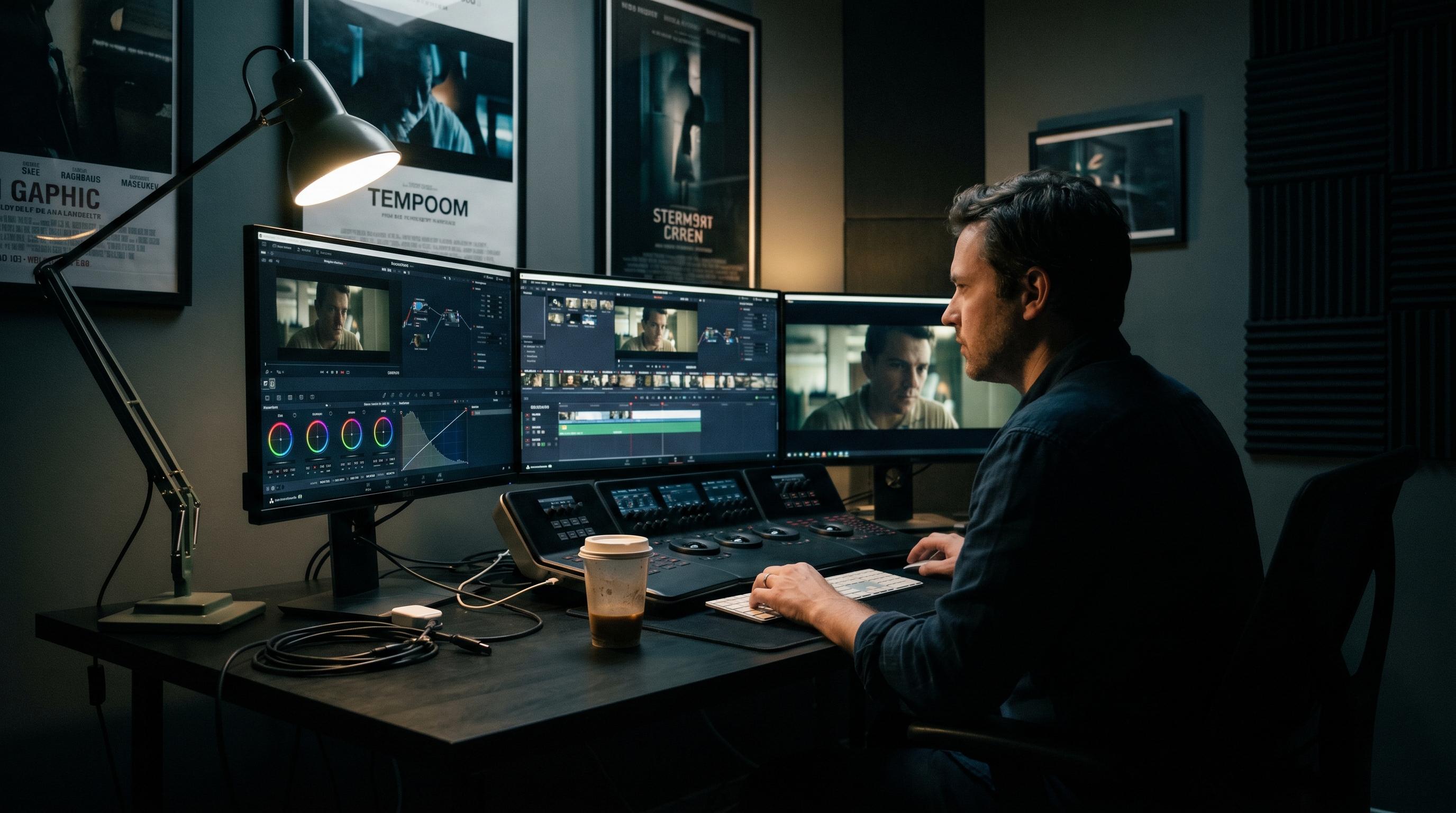
Post-production is where most of the invisible work of a commercial happens. The shoot generates raw material; post transforms it into a finished film. The timeline for this transformation is routinely underestimated at the project outset — and the underestimation rarely becomes visible until the delivery deadline is close.
Offline edit: 1–2 weeks
The editor works from the shoot footage to build the first assembly, then refines it into a first cut. For a standard 30-second spot, this takes three to five working days for an initial version, followed by internal review at the agency or production company before client presentation.
The offline edit is also where the director\'s vision for pacing, music, and narrative structure becomes concrete. Changes made at this stage are relatively inexpensive; the same changes requested after colour and sound work are significantly more disruptive.
Client revision rounds: 1–3 weeks (variable)
The offline edit is presented to the client. Client feedback is incorporated. Sometimes this happens in one round; more often it takes two or three. Each round requires a submission, a review period, a feedback collection process, and a revision session. At standard project tempos, each round takes three to five working days.
The approval round timeline is the most variable element in post-production. A client who can review quickly and give consolidated feedback accelerates delivery. A client whose approval process involves multiple internal stakeholders — each with separate sign-off requirements — can add weeks to a post schedule without any single individual being responsible for the delay.
Colour grade: 3–5 days
Once the picture is locked, the colourist works through the film shot by shot, establishing the overall look and ensuring consistency across scenes. This is technical and aesthetic work that requires both skill and time. For a 30-second spot with no significant colour complexity, three days is realistic. Larger productions with multiple locations, complex look development, or extensive VFX integration take longer.
Sound design and music: 3–5 days
Sound design — effects, ambience, sync — runs in parallel with or immediately after colour. Music licensing, if the track is pre-selected, can begin earlier; composition, if original music is being created, requires its own timeline that should be initiated well before picture lock.
Online and delivery: 1–2 days
Final mastering, technical QC, and format delivery for each required platform. This phase is often underscoped; multiple delivery formats (broadcast, digital, social, cinema) each have specific technical requirements that take time to prepare correctly.
Managing post-production time
The most effective way to manage post-production time is to compress the approval round cycle, not the technical work. Building a clear review and feedback protocol at the project outset — consolidated feedback, defined response windows, single point of client approval — is more valuable to the schedule than any production efficiency gain.